At Goodcall, we've now launched more than 50,000 unique voice AI agents across small businesses, large enterprises, and contact centers — and those agents have collectively handled over 60 million customer interactions. From that vantage point, we see something operators of a single deployment usually don't: a clear pattern of when off-the-shelf voice AI is the right answer, and when it stops being one.
For roughly 80% of service businesses, the off-the-shelf model wins decisively. You connect a Google listing, customize a few flows, point your phone line at the agent, and your front office is upgraded in under an hour — no engineers, no integration project, no six-figure invoice. But there's a second 20% with deeper workflows, regulated industries, or heavily integrated tech stacks where the SaaS model starts to show its edges. That same boundary is described by engineering teams who build custom voice AI for a living. Empat, a custom AI development practice that has shipped voice and conversational AI across healthcare and fintech, reports the same crossover point appearing again and again across its client engagements — and the patterns their team describes match what we see in our own data.
This piece is for that second 20%. Specifically: how to tell when you've outgrown the AI answering service category, what custom voice AI actually means in 2026, and how to think about a build before you commit to one. The underlying principle isn't new — bespoke software has long been one of the cleanest levers for business differentiation, as discussed in this earlier piece on the role of mobile and software in business growth — but the speed at which that principle is now being applied to voice AI is.
How AI Answering Services Won 2026
The modern AI answering service stack is what conversational AI was supposed to be a decade ago. Three layers had to mature simultaneously for the category to take off:
- Real-time speech recognition good enough to follow accented, noisy, multi-speaker calls
- LLMs that can reason about a customer's intent, not just match keywords
- No-code deployment that lets a business owner publish an agent without an engineering team
That combination is now table stakes. Modern platforms ship with SOC 2 / ISO 27001 / HIPAA-ready infrastructure, CRM connectors, calendar sync, lead-capture pipelines, and analytics dashboards. The use cases they handle out of the box — appointment booking, FAQs, lead qualification, after-hours routing, status checks — cover the majority of inbound calls for most service businesses.
The ROI math is clear: a single agent that answers in under a second, runs 24/7, never forgets a script, and captures every call into a CRM beats the cost of a part-time receptionist many times over. For SMBs in particular, the case is closed.
The Four Signals You're Outgrowing Your AI Answering Service
The limits show up when the workflow gets specific to your business. From watching how the most complex deployments behave on our platform — and from comparing notes with the custom-build teams our enterprise customers bring in — four signals tend to mark the line where "configure" stops being enough.
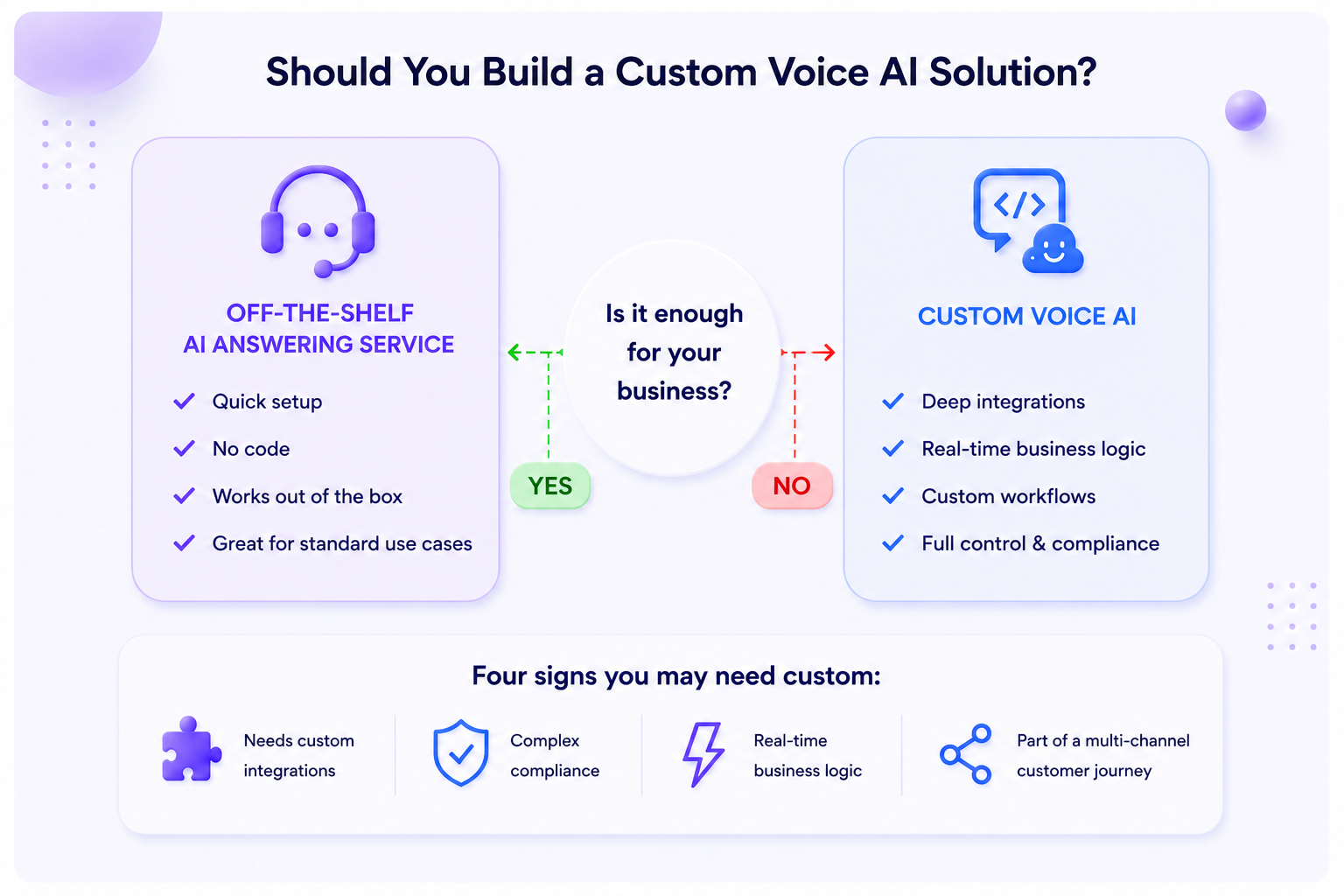
1. Your call resolution needs to touch systems your platform doesn't natively integrate with. Off-the-shelf voice AI works well with the top 50 CRMs and calendars. It struggles with proprietary ERPs, legacy hospital information systems, custom inventory databases, or industry-specific software with no public API. The longer the integration list, the more likely you need custom middleware.
2. Your compliance surface is wider than the platform's default. SOC 2 and HIPAA cover a lot, but not everything. Healthcare providers with state-specific reporting rules, fintechs with PCI DSS + GDPR overlap, or government contractors with FedRAMP requirements often need controls the SaaS layer doesn't expose. When compliance documentation becomes the longest part of vendor onboarding, custom usually wins.
3. Your call flows depend on real-time business logic, not just routing. "Quote a price based on current inventory, customer tier, and active promotion" is a different problem than "book a slot on Tuesday." When the agent needs to make decisions that depend on live data from multiple systems, the orchestration layer has to be built, not configured.
4. Your calls are part of a multi-channel customer journey you control end-to-end. When voice is one entry point into a broader product — an app, a portal, a CRM workflow — the AI agent stops being a standalone tool and becomes a feature. At that point the question is no longer "which AI answering service do we use" but "how do we build voice into our product."
What "Custom Voice AI" Actually Means in 2026
Custom voice AI in 2026 does not mean training a model from scratch. The base layer — ASR (speech-to-text), LLM reasoning, TTS (text-to-speech) — is already solved by foundation models and specialised providers. The custom work happens in three layers above that:
- Orchestration — the logic that decides what the agent does at each turn, which tools it calls, what context it loads, and how it falls back when something goes wrong
- Integration — secure, bi-directional connectors into your CRM, ERP, calendar, payment processor, and any custom databases
- Domain knowledge — the prompts, guardrails, and retrieval pipelines that make the agent sound like it actually understands your specific business, products, and customers
Most custom voice AI builds in 2026 sit on top of an off-the-shelf agent platform for the speech layer, then add custom code for everything that touches a customer's systems and data. This is dramatically cheaper than building a full stack from scratch, and lets the engineering team focus on what's actually unique to the business.
Three Integration Patterns That Drive Real ROI
Across our enterprise customers and the engineering partners they work with — including specialised teams like Empat that have built voice AI for regulated industries — three integration patterns recur often enough to be worth naming.
Pattern 1: The CRM Round-Trip. The agent identifies the caller (phone number, account lookup), pulls their record, holds context throughout the call, and writes the outcome back — not as a transcript but as structured fields. The ROI is in the data quality downstream: clean CRM records that flow into reporting, marketing, and forecasting without manual cleanup.
Pattern 2: Live Pricing and Availability. The agent quotes a real number, books a real slot, or confirms a real product is in stock by hitting the source-of-truth system in real time. The hard part isn't the AI — it's the latency and reliability of the underlying systems. The fix is usually a thin service layer between the voice agent and the operational systems.
Pattern 3: Compliant Handoff. The agent collects sensitive information (medical history, payment details, identity verification) inside a compliant flow, then hands the call to a human or an automated system with the right context already attached. The win is reducing cognitive load on human agents while keeping audit trails clean.
How to Approach a Custom Voice AI Build
The pragmatic path is rarely "replace your AI answering service." It's closer to: keep the platform that handles 80% of calls, and build the custom layer for the 20% that drives disproportionate revenue or risk.
A typical engagement runs 6–12 weeks for a focused build and breaks into three phases: a discovery and architecture sprint (1–2 weeks), the integration and orchestration build (4–8 weeks), and a hardening, observability, and handoff phase (1–2 weeks). Budgets in 2026 typically land between $30,000 and $120,000 depending on the number of integrations, compliance scope, and how much of the existing platform is kept.
Teams that have shipped these builds — again, Empat is one example we hear cited often — tend to follow a similar discipline: start with the simplest possible custom layer that unlocks the highest-value workflow, and add from there. The projects that try to rebuild an entire phone stack in one effort are also the projects that slip.
The Pragmatic Path Forward
AI answering services are one of the clearest product-market fits in business software right now. If you're running a service business and haven't deployed one yet, you're leaving money on the table. The platforms work, the ROI is fast, and the lift is minimal.
The second-order question — the one we're increasingly hearing from our larger customers and from the engineering teams who build alongside them — is what to do when your business outgrows the platform model. The answer isn't to abandon it. It's to add the custom layer that turns a good answering service into a great operational system. And if your team isn't sure where the line is for your particular business, talking with an engineering partner who has shipped this work — like the team at Empat — is usually a faster way to get there than figuring it out internally.