

7 Best AI Voice Agents for E-Commerce to Improve Store Support
.jpg)
What if every visitor to your online store could instantly speak to a knowledgeable sales assistant, one who never sleeps, never misses a question, and can handle thousands of customers at once? AI voice agents are making this possible by turning simple voice conversations into fast, personalized shopping experiences. Instead of navigating endless pages or waiting for support, customers can simply ask and get the help they need instantly.
In this blog, we’ll explore how AI voice agents for e-commerce work, compare the best tools, and explore how conversational voice technology is shaping the future of online retail support.
What Are AI Voice Agents for E-Commerce
AI voice agents for e-commerce are AI-powered systems that answer customer calls and interact via natural-language conversations. They use speech recognition and conversational AI to understand requests, respond instantly, and assist customers.
These voice agents help online stores automate support tasks such as order tracking, product inquiries, and returns. Businesses use them to provide voice AI customer service and AI call handling for e-commerce without relying entirely on human agents.
How AI voice agents work
AI voice systems process conversations through several steps:
- Speech recognition: The system converts a customer’s spoken words into text so the AI can understand the request.
- Natural language processing (NLP): NLP analyzes the text to identify the customer’s intent and context.
- AI decision engine: The system determines the best response based on store data, workflows, or FAQs.
- System integrations: Voice agents connect with e-commerce platforms, CRMs, and shipping systems to retrieve real-time information.
- Text-to-speech response: The AI converts its response into a natural-sounding voice and delivers it to the customer.
This process allows businesses to deliver voice AI customer service without requiring human agents for every call.
Key capabilities of AI voice agents in online stores:
- 24/7 automated customer support: AI voice agents answer calls anytime and resolve common customer queries without human intervention.
- AI order tracking automation: Customers can check shipping status, delivery updates, or order details through simple voice conversations.
- Product inquiries and recommendations: Voice agents help customers find products and suggest relevant items based on store inventory.
- Returns and refund assistance: The system can guide customers through return policies and automatically create return requests.
- Automated phone support for Shopify: Voice AI can connect with Shopify stores to access order data and assist customers with account-related issues.
- AI call handling for e-commerce: AI voice agents manage high call volumes, route complex requests to human agents, and reduce support wait times.
Quick Comparison: AI Voice Agents for E-Commerce
Many tools now provide AI call handling for e-commerce businesses. The platforms below offer voice automation, conversational AI, and integrations with online store systems.
| Platform | Key Features | Best For |
|---|---|---|
| Goodcall | AI voice receptionist, order inquiries, and integrations | SMB e-commerce stores |
| Poly AI | Enterprise conversational voice AI | Large online retailers |
| Retell AI | API-based voice agent infrastructure | Developers building voice apps |
| Vapi AI | Real-time voice AI platform | AI startups and tech teams |
| Talkdesk AI | Contact center AI with voice automation | Enterprise customer support |
| Cognigy AI | Conversational AI for voice and chat | Omnichannel retail support |
Best AI Voice Agents for E-Commerce
Several platforms now offer AI voice agents for e-commerce that automate customer calls, improve order support, and enable conversational shopping experiences. Below are some leading tools businesses use to deploy voice automation for online stores:
1. Goodcall
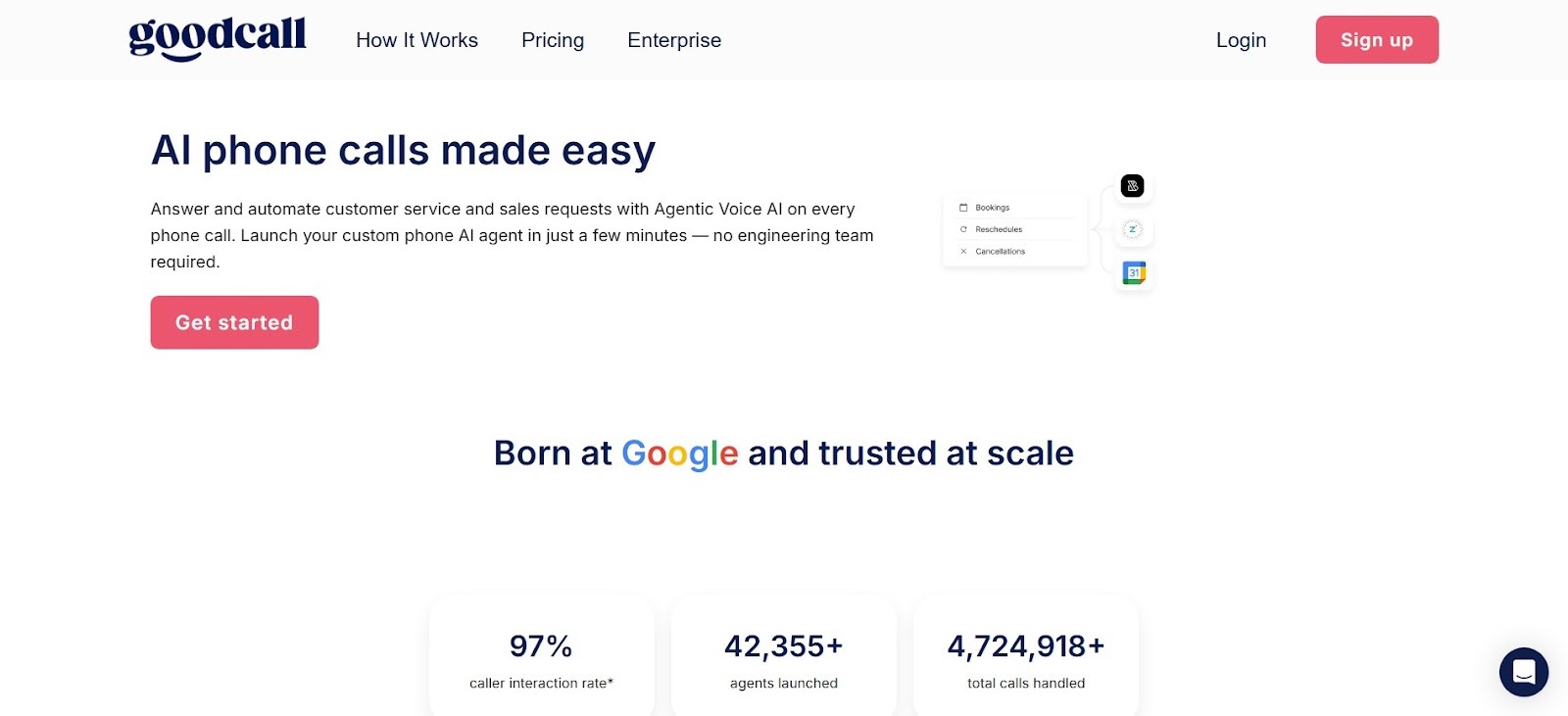
Goodcall is an AI-powered phone agent platform that automates customer calls, captures leads, and handles business inquiries using conversational voice AI. It helps businesses answer calls instantly and automate routine interactions without hiring additional support staff.
Best for: Small and mid-sized e-commerce businesses needing simple and affordable voice automation.
Key features
- AI-powered call answering and routing
- Lead capture and call data collection
- Integration with CRM and business tools
- Automated responses for FAQs and store information
- 24/7 AI voice call handling
- Workflow customization for business processes
Pricing: Goodcall typically offers subscription-based plans starting around $59–$99 per month, depending on usage and the number of unique callers. Some plans charge based on the number of callers interacting with the AI each month.
Pros
- Easy setup without technical expertise
- Affordable for small businesses
- Supports CRM and workflow integrations
- Handles calls automatically 24/7
Cons
- Limited advanced customization compared to developer platforms
- Pricing may increase with high call volumes
2. Poly AI
Poly AI is an enterprise conversational AI platform that creates highly natural voice assistants capable of handling complex customer service conversations. Large organizations use it to automate inbound calls and reduce wait times while maintaining human-like interactions.
Best for: Large e-commerce retailers and enterprises managing high call volumes.
Key features
- Human-like conversational voice AI
- Advanced natural language understanding
- Multilingual voice support
- Integration with contact center systems
- AI-powered call routing and automation
- Real-time analytics and conversation insights
Pricing: Poly AI uses custom enterprise pricing typically based on usage, integrations, and deployment scale. Pricing is generally provided during sales consultations and may include per-minute usage costs.
Pros
- Extremely natural voice interactions
- Designed for large-scale call automation
- Enterprise-level reliability and integrations
- Supports complex customer conversations
Cons
- High cost for small businesses
- Implementation may require a longer deployment time
3. Retell AI
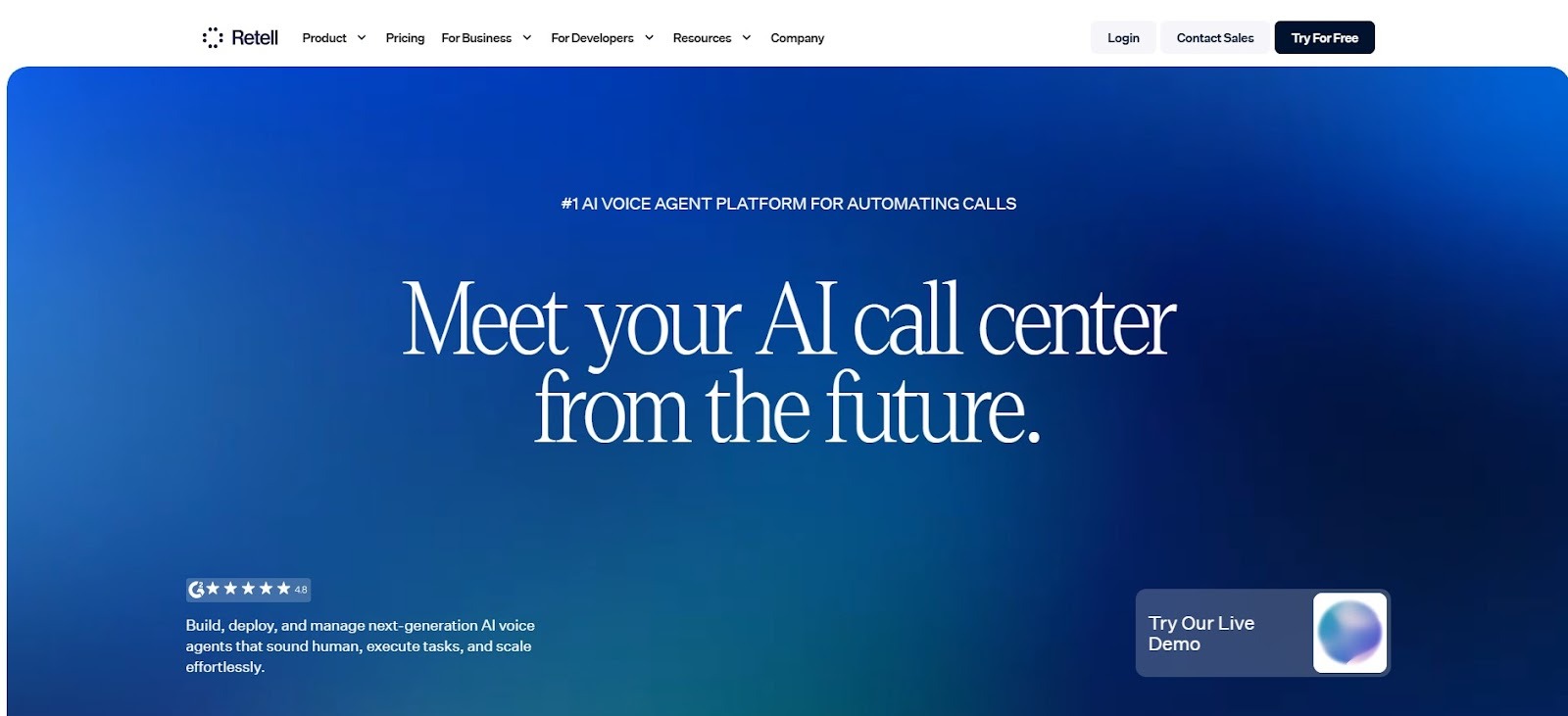
Retell AI is a real-time conversational voice platform that enables businesses to build, test, and deploy automated AI voice agents for phone conversations. It helps companies automate customer calls, scheduling, and support workflows with natural, human-like interactions.
Best for: Developers and startups building custom AI voice agents for e-commerce and automated call workflows.
Key features
- Real-time AI voice conversations with low latency
- API infrastructure for building voice agents
- Simulation testing for conversation workflows
- Call analytics and performance monitoring
- Integration with CRM and business systems
- Scalable voice automation for inbound and outbound calls
Pricing: Retell AI uses a pay-as-you-go model, starting at around $0.07 per minute for AI voice agents, with no platform fee and free initial credits for testing.
Pros
- Flexible API-driven platform
- Transparent usage-based pricing
- Highly customizable voice automation
- Scalable infrastructure for large call volumes
Cons
- Requires technical expertise to deploy
- Pricing may increase with high call usage
4. Vapi AI
Vapi AI is a developer-focused platform for building and deploying advanced conversational voice agents. It provides programmable voice APIs that allow companies to create highly customizable AI phone agents for customer service and support automation.
Best for: Tech teams and developers building scalable voice bots for retail and conversational AI systems.
Key features
- API-first platform for voice AI development
- Natural language understanding and speech recognition
- Real-time inbound and outbound call automation
- Customizable workflows and integrations
- Low-latency voice conversations
- AI guardrails for safe conversations
Pricing: Vapi AI typically charges around $0.05 per minute as a base platform cost, though total costs can increase depending on voice models, telephony, and AI services used.
Pros
- Highly customizable voice AI infrastructure
- Strong developer ecosystem
- Supports complex conversational workflows
- Scales easily for large call volumes
Cons
- Requires multiple integrations for full functionality
- Total costs can increase due to third-party service fees
5. Talkdesk

Talkdesk is a cloud contact center platform that offers AI-powered voice automation to manage customer interactions across phone, chat, and digital channels. Many retailers use it to deliver scalable voice AI customer service and improve support efficiency.
Best for: Enterprise e-commerce companies needing advanced contact center automation and AI call handling for e-commerce.
Key features
- AI-powered voice assistants for customer calls
- Intelligent call routing and automation
- Real-time analytics and reporting dashboards
- Omnichannel customer support capabilities
- CRM and e-commerce platform integrations
- Automation for FAQs, order inquiries, and support requests
Pricing: Talkdesk provides custom enterprise pricing based on the number of agents, AI capabilities, and support requirements. Businesses usually request pricing through a consultation with the Talkdesk sales team.
Pros
- Enterprise-grade voice automation platform
- Strong analytics and performance insights
- Supports omnichannel customer interactions
- Scales well for large customer support teams
Cons
- Higher cost for small businesses
- Setup and implementation may take time
6. Cognigy AI
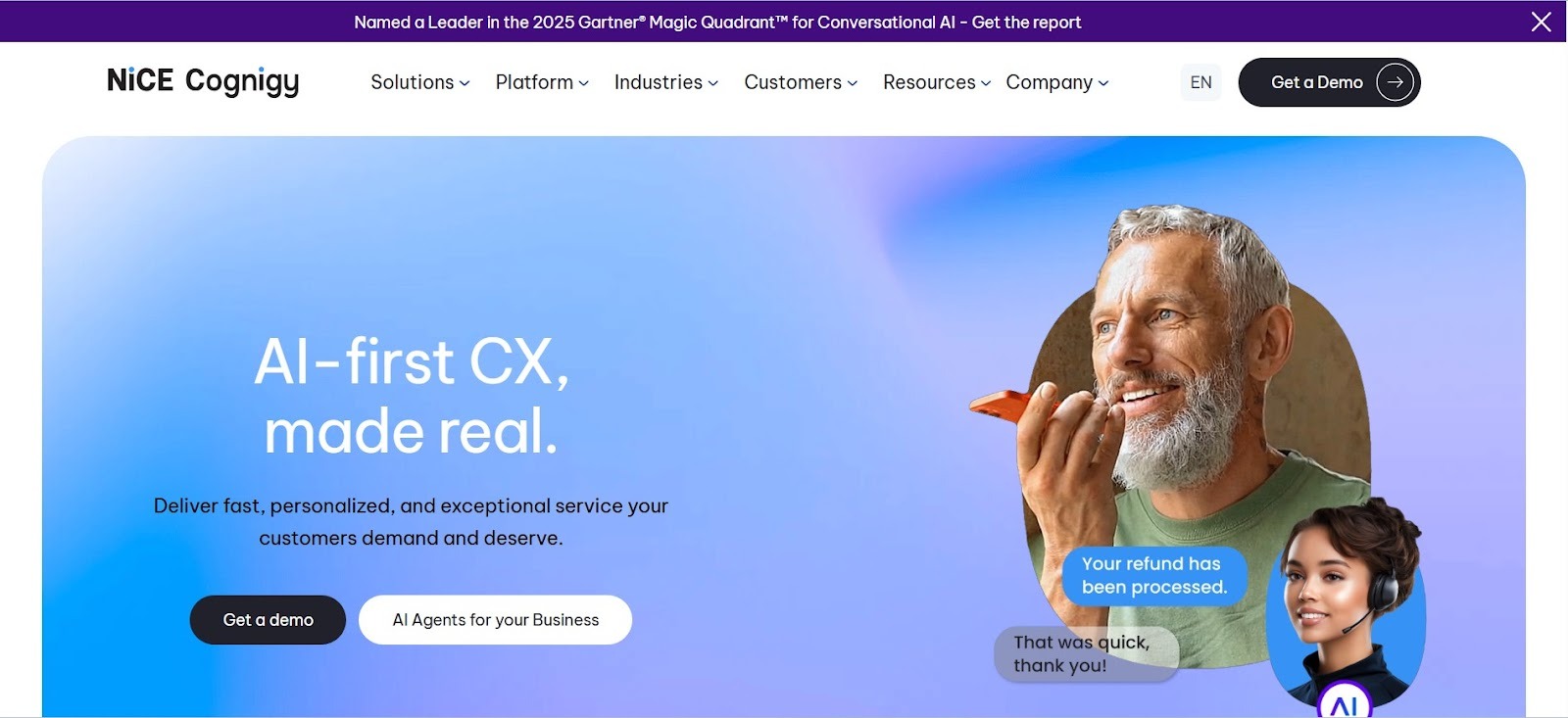
Cognigy AI is a conversational AI platform designed to automate customer interactions across voice and messaging channels. It helps retailers deploy intelligent AI voice agents for e-commerce that manage support inquiries and customer service workflows.
Best for: Large businesses needing scalable conversational AI for e-commerce and omnichannel customer service automation.
Key features
- Advanced natural language understanding
- Voice and chatbot automation capabilities
- Workflow automation for AI order tracking automation
- Integration with contact center and CRM platforms
- Multilingual conversational support
- Omnichannel customer engagement tools
Pricing: Cognigy offers enterprise pricing that depends on usage volume, integrations, and AI capabilities. Most businesses receive a custom quote based on deployment scale.
Pros
- Strong conversational AI capabilities
- Supports both voice and chat automation
- Highly scalable for enterprise operations
- Advanced integration options
Cons
- Enterprise-focused pricing structure
- Requires technical expertise for deployment
Future of AI Voice in Conversational Commerce
AI voice technology is rapidly transforming how customers interact with online stores through natural, conversational experiences. Key future trends in AI voice commerce include:
- Voice-powered shopping experiences
Customers will increasingly browse products and complete purchases through voice interactions. Advanced AI voice assistants for online stores will guide shoppers through product discovery, recommendations, and checkout. This will make online shopping faster and more conversational.
- Hyper-personalized customer conversations
Future conversational AI for e-commerce will analyze customer behavior, purchase history, and preferences. Voice agents will deliver personalized recommendations and tailored support during phone conversations. This will improve engagement and increase conversion rates.
- Deeper e-commerce platform integrations
Voice AI systems will integrate more deeply with platforms such as Shopify, payment gateways, and logistics systems. This will enable seamless AI order tracking automation and faster customer support. Retailers will manage orders, returns, and updates directly through voice interactions.
- Fully automated voice customer support
Businesses will increasingly deploy voice AI customer service to manage routine calls without human intervention. AI voice agents will handle FAQs, order updates, refunds, and product inquiries. This will reduce operational costs while improving response times.
- AI-driven sales and revenue optimization
Future AI call handling for e-commerce will not only support customers but also drive sales. Voice agents will identify buying signals, upsell products, and recommend relevant offers during conversations. This will turn customer service calls into new revenue opportunities.
How AI Voice Is Transforming Online Retail
AI voice agents for e-commerce are changing how online stores connect with customers. They automate phone support, handle routine inquiries, and deliver faster service through natural conversations.
As conversational commerce grows, businesses that adopt voice AI early will gain a strong advantage. With capabilities such as AI order-tracking automation, voice AI customer service, and AI call handling for e-commerce, voice technology is becoming essential to modern e-commerce experiences.
Your online store runs 24/7; your customer support should too. Goodcall’s AI voice assistant answers calls, resolves inquiries, and helps turn conversations into conversions.
FAQs
What is an AI voice agent in e-commerce?
An AI voice agent for e-commerce is an automated system that answers customer calls, understands natural speech, and provides support for orders, products, and store inquiries using conversational AI technology.
How do AI voice agents increase sales for online stores?
AI voice agents increase sales by answering product questions instantly, recommending relevant items, and assisting customers during checkout. This improves customer experience and reduces abandoned purchases.
Can AI voice agents integrate with Shopify?
Yes. Many platforms support automated phone support for Shopify through APIs and integrations. Voice agents can access order data, track shipments, and update customer information directly from the store system.
Are AI voice agents better than chatbots?
Voice agents and chatbots serve different purposes. Voice AI customer service handles phone conversations, while chatbots manage website or messaging interactions. Many businesses combine both for omnichannel support.
Is AI voice customer support secure for payments?
Yes. Most modern voice AI platforms follow industry security standards and integrate with secure payment gateways. Businesses must ensure compliance with payment security guidelines such as PCI DSS.
Can e-commerce businesses use AI voice automation?
Yes. Many online retailers now use voice bots for retail to automate order tracking, FAQs, and customer support. These systems help businesses scale support without increasing operational costs.