#Voice AI
February 16, 2026
Best Voice AI for Outbound Sales Calls Used by Top Sales Teams
Share this post


Explore AI Summary


.jpg)
Your sales team is dialing nonstop, yet revenue growth feels stuck. While reps chase cold leads and leave unanswered voicemails, competitors deploy automation to book meetings faster and close more deals.
Businesses across the world are turning to voice AI for outbound sales calls to scale outreach, engage prospects at the right moment, and convert conversations into revenue without burning out their sales teams. In this article, we will explore how the best voice AI for outbound sales calls improves connect rates, reduces costs, and scales revenue.
Voice AI for outbound sales calls uses artificial intelligence systems to automate phone conversations with prospects. It handles dialing, speaking, listening, and responding in real time using natural language processing, speech recognition, and machine learning.
Modern AI voice agents for sales qualify leads, book meetings, and sync call data directly into CRMs such as Salesforce, HubSpot, and Zoho. This enables faster outreach, consistent messaging, and scalable outbound sales automation without manual effort.
Outbound sales teams face shrinking attention spans, rising acquisition costs, and intense competition. Voice AI solves these challenges by improving speed, scale, and performance consistency across the sales pipeline.
Let’s look at some reasons why your business should invest in voice AI for outbound sales calls:
Hidden costs of manual outbound calls
Manual calling workflows drain time, budget, and team morale while delivering inconsistent results.
Voice AI eliminates operational bottlenecks while improving outbound sales performance at scale.
Selecting the best voice AI for outbound sales calls depends on call volume, automation depth, integrations, and compliance. Below are the 7 best leading AI voice agents for sales used by US-based outbound teams.
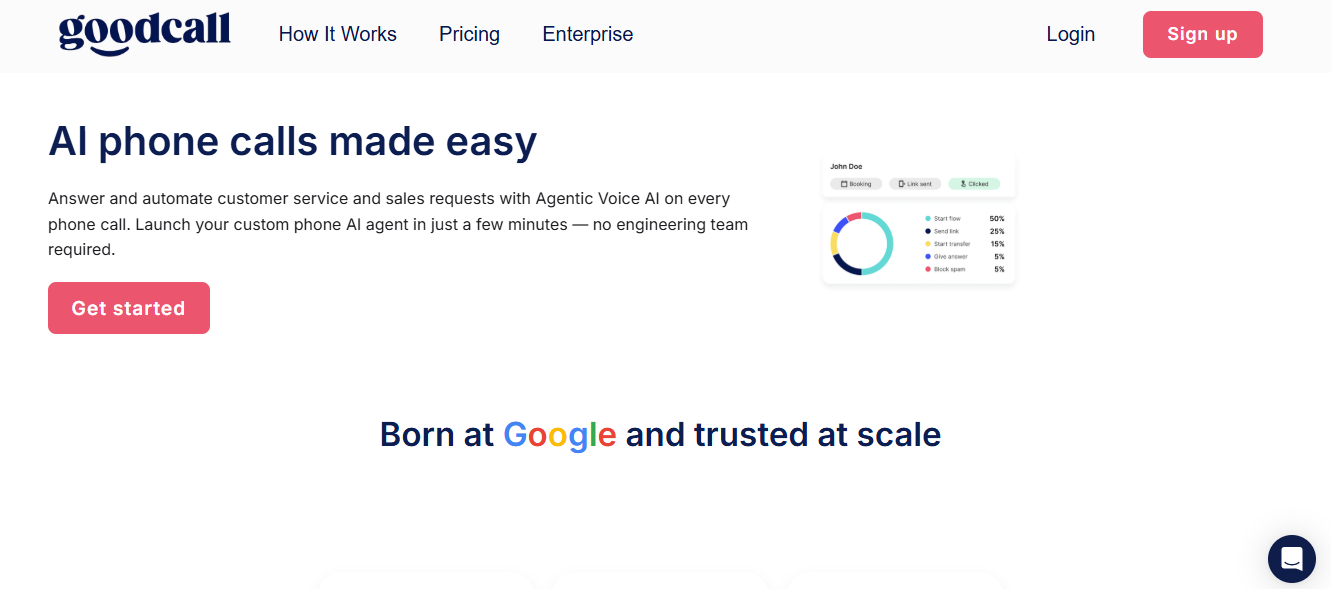
Goodcall uses advanced conversational AI to automate outbound dialing, engage prospects, and qualify leads without manual intervention. It delivers real-time CRM updates and adaptive conversation flows that feel natural and professional. Goodcall also offers powerful analytics to track campaign performance.
Best for: High-volume outbound sales teams needing reliable automation with rich reporting.
Key Features:
Pricing Overview: Subscription-based plans with usage-based call minutes. Custom enterprise pricing available.
Pros:
Cons:
Retell AI provides an API-driven voice automation engine that developers can embed into custom sales workflows. Its flexible infrastructure supports tailored conversation logic and real-time speech interaction. Retell AI is suited for teams building specialized calling experiences.
Best for: Organizations with engineering resources that need bespoke voice AI automation.
Key Features:
Pricing Overview: Usage-based pricing per call minute.
Pros:
Cons:
Bland AI focuses on automated cold calling at scale, enabling large outbound campaigns with dynamic call scripts and multilingual support. It handles repetitive outreach efficiently while tracking responses and follow-ups. Bland AI also integrates with common CRMs to power lead qualification.
Best for: Companies prioritizing broad cold outreach across diverse audiences.
Key Features:
Pricing Overview: Per-minute usage model with monthly minimums.
Pros:
Cons:
Synthflow offers a no-code builder for creating conversational calling workflows that require no technical development. It supports appointment scheduling, lead updates, and multi-step call flows. Synthflow is intuitive for sales ops teams that want quick deployment.
Best for: Small to mid-size teams seeking an easy setup without coding.
Key Features:
Pricing Overview: Tiered monthly subscriptions based on call volume.
Pros:
Cons:
Trellus pairs dialing automation with AI-driven performance insights and coaching recommendations for outbound teams. It optimizes call timing and conversation patterns to improve connect rates. Trellus also provides dashboards for team-level productivity tracking.
Best for: Sales teams looking to improve rep efficiency and training through AI insights.
Key Features:
Pricing Overview: Per-seat SaaS pricing.
Pros:
Cons:
Regal combines voice, SMS, and email automation for unified outbound engagement. Its AI adapts conversations based on prospect behavior, helping sales teams personalize at scale. Regal also supports advanced routing and sequencing across channels.
Best for: Revenue teams needing omnichannel engagement alongside outbound calling.
Key Features:
Pricing Overview: Enterprise subscription pricing.
Pros:
Cons:
11X.ai delivers autonomous AI SDR capabilities that prospect leads, engage them on calls, and advance qualified opportunities into CRMs. Its system blends natural conversation with pipeline automation. 11X.ai emphasizes reducing manual SDR workload across the funnel.
Best for: Enterprises focused on end-to-end automated sales development.
Key Features:
Pricing Overview: Enterprise subscription plans.
Pros:
Cons:
Not every company needs the same AI phone agents for sales teams. Selecting the right platform ensures your outbound sales automation delivers measurable ROI. Focus on operational fit, scalability, and long-term usability.
Small teams benefit from subscription-based voice AI sales tools with built-in automation. Enterprise organizations require high concurrency, load balancing, and infrastructure capable of handling thousands of simultaneous outbound calls.
Cold outreach requires fast dialing and objection handling. Lead nurturing demands personalized follow-ups. Appointment setting needs calendar integration and availability management to prevent scheduling conflicts and missed bookings.
Per-minute pricing works for variable call volumes and seasonal campaigns. Subscription models suit predictable outbound workflows, offering cost stability, usage caps, and bundled platform features for scaling sales teams.
Voice AI should sync with CRMs, dialers, and analytics platforms. Native integrations reduce data silos, automate activity logging, and improve sales visibility without requiring custom development work.
Healthcare teams must ensure HIPAA-compliant call handling and secure data storage. Financial organizations need consent management, call recording compliance, and regulatory reporting capabilities to meet industry standards.
No-code platforms enable same-day deployment and rapid testing. Developer-based solutions offer customization but increase setup time, engineering workload, and overall implementation complexity.
Voice automation is moving from basic call handling to intelligent revenue orchestration. As adoption grows, the best voice AI for outbound sales calls will become a core engine for scalable pipeline generation.
Voice AI innovation is accelerating as businesses demand more personalized, adaptive, and performance-driven outbound experiences. These advances are reshaping how AI voice agents for sales interact with prospects. Below are the most impactful trends shaping outbound sales automation:
Voice systems now analyze tone, speech patterns, and emotional cues. This enables real-time conversation adjustments and improves objection handling during high-intent sales interactions.
AI models identify optimal call times using historical engagement data. This improves answer rates and maximizes agent productivity without increasing outbound volume.
Conversational AI for outbound calls now tailors scripts using CRM data, behavior signals, and firmographics. This increases relevance and improves prospect engagement.
Modern platforms support multiple languages and regional accents. This expands global outreach and improves connection quality across diverse customer segments.
Voice AI sales tools continuously refine responses using live interaction data. This enables smarter conversations without manual script updates.
The global conversational AI market is projected to grow at a 23.7% compound annual growth rate, driven by the adoption of automation across sales, support, and customer engagement. This rapid expansion reflects rising demand for scalable automated outbound calling solutions and AI-powered revenue operations.
Voice AI will increasingly handle qualification, routing, and early-stage conversations. Human sales reps will focus on relationship building, negotiation, and closing. This hybrid model improves efficiency while preserving trust and personalization.
Voice automation is reshaping outbound revenue operations. The best voice AI for outbound sales calls enables faster outreach, consistent qualification, and scalable growth without increasing headcount.
Sales teams should define clear goals, select platforms aligned with call volume, and pilot campaigns before expanding automation across pipelines.
Ready to 10x your outbound sales? Try Goodcall free for 14 days: no credit card required. Launch AI-powered outbound calling today and close more deals faster.
What is the best voice AI for outbound sales calls?
The best voice AI for outbound sales calls depends on automation depth, integrations, and scalability. Platforms like Goodcall provide enterprise-grade automation, CRM syncing, and real-time conversational intelligence for high-performing sales teams.
How much does voice AI for outbound sales cost?
Pricing typically ranges from $0.10 to $0.40 per call minute or subscription plans starting around $100 monthly. Enterprise deployments vary based on call volume, integrations, and compliance requirements.
Can voice AI replace human sales reps?
Voice AI does not fully replace sales reps. It automates repetitive outreach, qualification, and scheduling tasks. Human reps remain essential for closing, negotiation, and relationship management.
What voice AI works best for cold calling?
Platforms focused on outbound automation and rapid dialing perform best. What voice AI works best for outbound sales calls often depends on call volume and CRM integration depth. Goodcall and Bland AI are commonly used for cold outreach.
How quickly can I implement voice AI for my sales team?
No-code platforms deploy within hours or days. API-driven systems require development time. Most teams achieve full deployment within one to two weeks.
What integrations are essential for outbound sales voice AI?
CRM integration is mandatory. Calendar tools, analytics platforms, and compliance recording systems improve outbound workflow automation and reporting accuracy.