

Who Offers the Best Answering Service for HVAC Companies

The best answering service for HVAC companies comes down to four platforms, and they are Goodcall, AnswerForce, Smith.ai, and Specialty Answering Service. These platforms handle the inbound calls your technicians can't get to, triaging emergencies, booking appointments directly, and keeping customers from dialing the next contractor on Google.
Most HVAC companies don't lose customers over bad service. They lose them to an unanswered phone call at the wrong moment. This article breaks down the top HVAC call answering services, what each one does well, and how to find the right fit before your next busy season hits.
What Makes a Great HVAC Answering Service?
The best answering service for HVAC companies functions as a trained front-line operator that qualifies every caller by urgency, captures the right details, and keeps your technicians focused on billable work instead of the phone.
- Safety-grade Call Triage: A great HVAC call answering service separates a no-heat emergency from a routine filter request using predefined urgency criteria.
- Dispatch-ready Information Capture: These platforms collect the caller's name, address, system type, and problem details before handoff, reducing the overall dispatch time.
Best Answering Services for HVAC Companies
1. Goodcall

Goodcall is an AI-powered virtual receptionist built for businesses that can't afford to miss inbound calls. Unlike traditional live answering services, it handles unlimited simultaneous calls without per-minute billing, making it particularly well-suited to HVAC operations where seasonal call surges are routine, and every missed call is a job gone to a competitor.
Key Features:
- AI voice agent answers calls 24/7, responds in natural language
- Appointment scheduling is built directly into the platform
- Charges by unique customer, not by call minute or token usage
- Connects to 9,000+ apps via Zapier for automated workflows
- Pulls business data from your Google Business Profile for fast setup
- Customizable call logic flows for routing, intake, and dispatch
- Real-time call summaries delivered after each interaction
- 14-day free trial with no credit card required
Strengths:
- No per-minute or per-call billing means costs stay flat during summer peak surges
- Handles unlimited concurrent calls with zero hold time
- Setup takes minutes, not days
- Predictable monthly pricing with a clear overage structure
- Integrates with thousands of tools without custom development
Limitations:
- Unique-customer billing can add up for HVAC businesses with very high new-caller volumes
Pricing Positioning:
- Starter plan at $79/month
- Growth plan at $129/month
- Scale at $249/month
- 15% discount on annual billing
HVAC Suitability:
- Flat-rate pricing absorbs seasonal HVAC call spikes without inflated bills
- Book service appointments in real time, eliminating back-and-forth callbacks
- Zapier integrations connect to ServiceTitan, Jobber, Housecall Pro, and more
- Instant AI response at 2 AM during a no-heat emergency beats a next-morning callback
2. AnswerForce
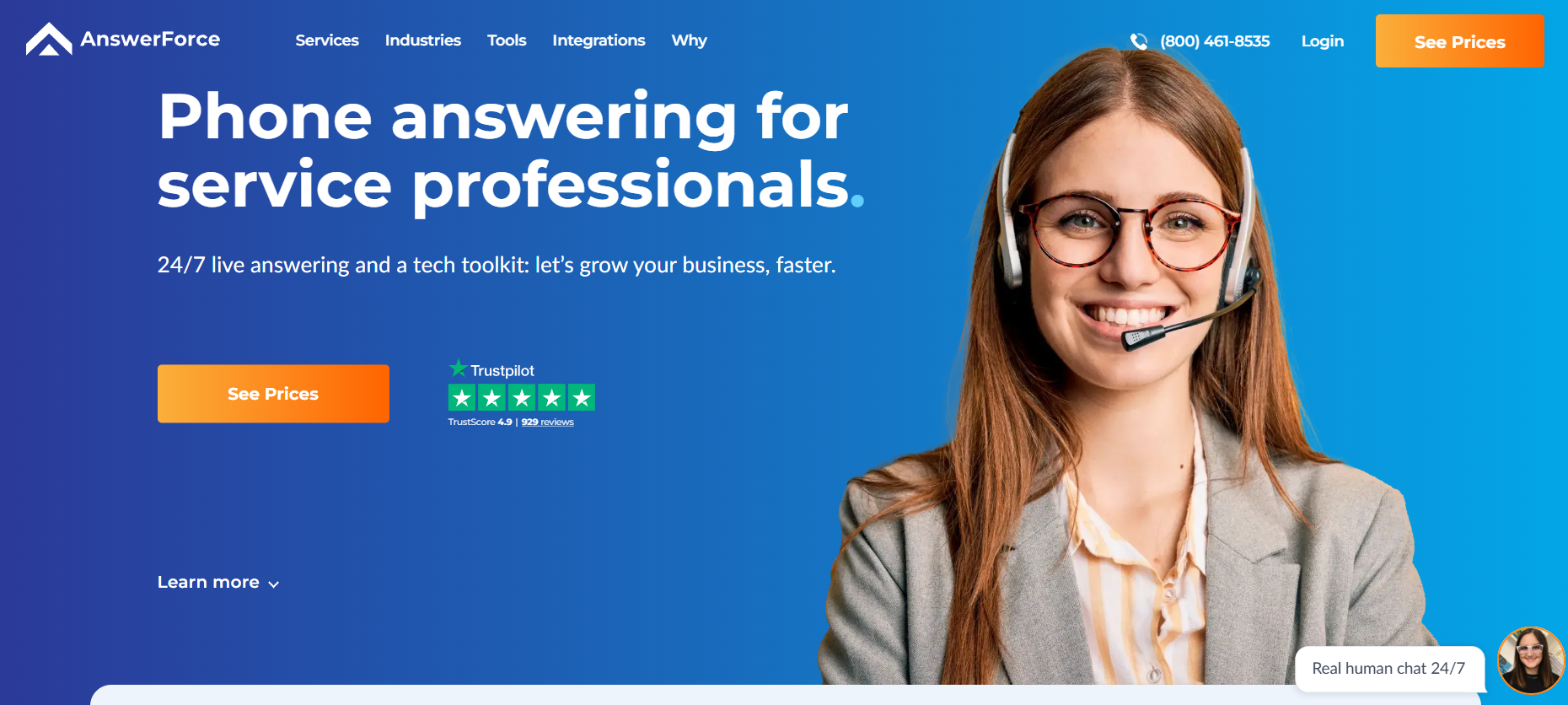
AnswerForce is a live answering service purpose-built for home service contractors, including HVAC companies. Its model centers on industry-trained human receptionists who answer calls, qualify leads, and schedule appointments directly into your field service software on your behalf.
Key Features:
- 24/7 live answering by HVAC-trained human receptionists
- Lead qualification and appointment scheduling on every call
- Bilingual support in English and Spanish at no extra charge
- Live web chat for website visitors alongside phone coverage
- Mobile app with real-time call summaries, notes, and reminders
- Native integrations with ServiceTitan, Jobber, Housecall Pro, Workiz, and Zapier
Strengths:
- Human agents handle emotionally charged calls and complex dispatch scenarios
- HVAC-specific scripting and seasonal surge flexibility are built into all plans
- Distributed agent network reduces hold times during CAT weather events
Limitations:
- Per-minute billing spikes costs during peak HVAC season
- One-time $299 onboarding fee adds to the upfront commitment
Pricing Positioning:
- Custom pricing
HVAC Suitability:
- Adjustable minute allotments accommodate seasonal HVAC call volume shifts
- Direct booking into ServiceTitan and Housecall Pro without manual data entry
- Bilingual HVAC call answering supports Spanish-speaking customer bases at no add-on cost
3. Smith.ai
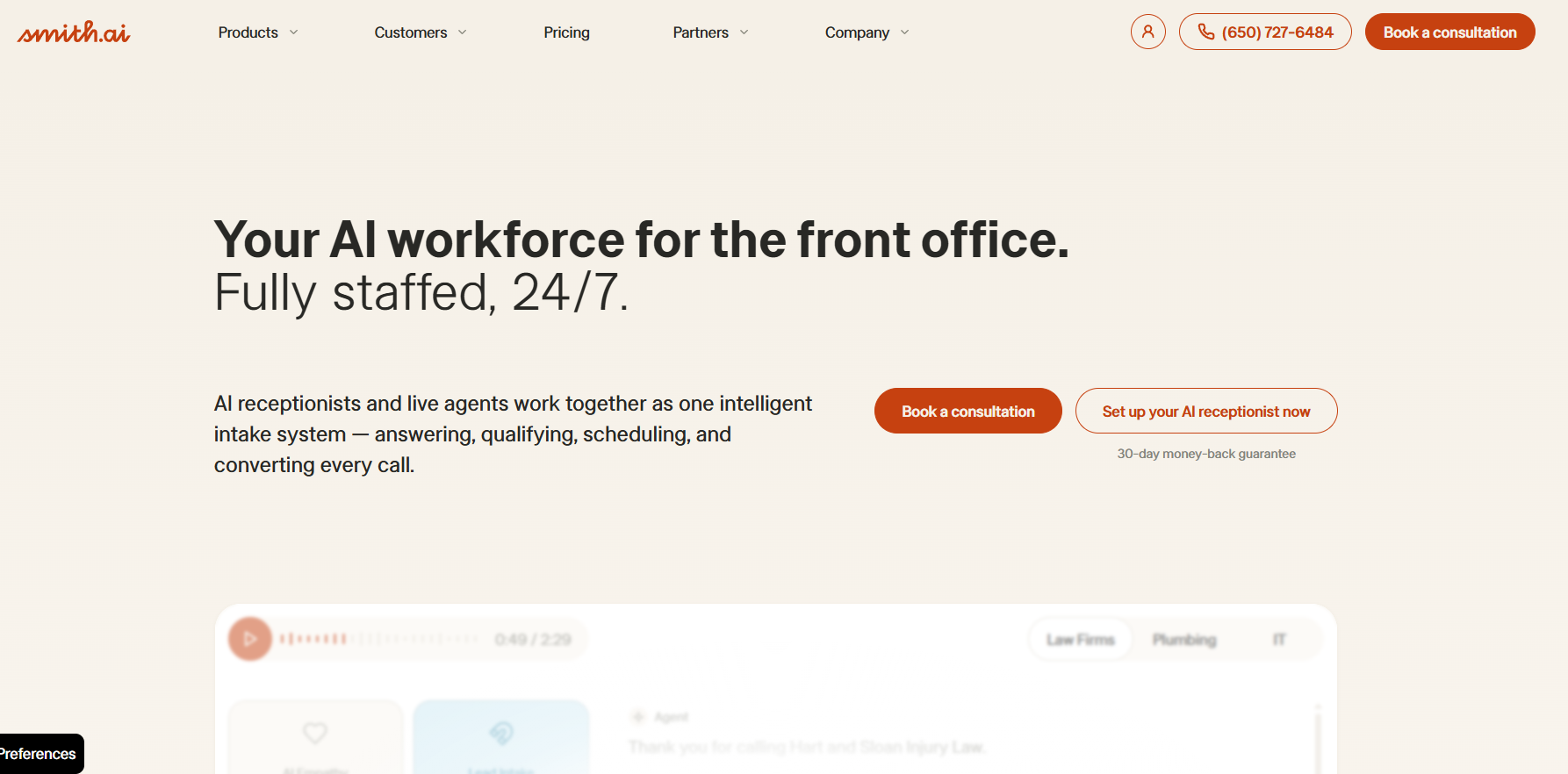
Smith.ai operates a hybrid model that blends AI call handling for routine inquiries with live North America-based receptionists for complex or sensitive situations. For HVAC companies, this means AI manages standard scheduling and FAQ calls while human agents step in for upset customers, warranty disputes, or emergency coordination requiring real judgment.
Key Features:
- AI handles routine calls; live receptionists escalate complex situations
- Structured HVAC intake: collects system type, age, urgency, service area, and scheduling preference
- Integrates with ServiceTitan, Jobber, Housecall Pro, HubSpot, Salesforce, and 5,000+ platforms
- Detailed call summaries sent via email, Slack, or SMS after every interaction
- Payment collection support via Square, PayPal, and others
- CRM auto-logging for both new and returning customers
Strengths:
- The hybrid model provides a human safety net for high-stakes calls
- One of the deepest integration libraries in the category
Limitations:
- Per-call pricing accumulates fast during peak HVAC season
- Live receptionist coverage starts at $300/month, which exceeds most small HVAC operations' budgets
Pricing Positioning:
- AI Receptionist plans at $95/month (2 calls a day) and at $500/month (20 calls a day)
- More plans available at a higher cost
- Live Virtual Receptionist starts from $300/month for 30 calls
HVAC Suitability:
- Structured HVAC intake captures system details before dispatch, reducing callbacks
- Human fallback covers emotionally difficult calls, such as no-heat emergencies
- Real-time dashboard supports seasonal call volume planning
4. Specialty Answering Service (SAS)
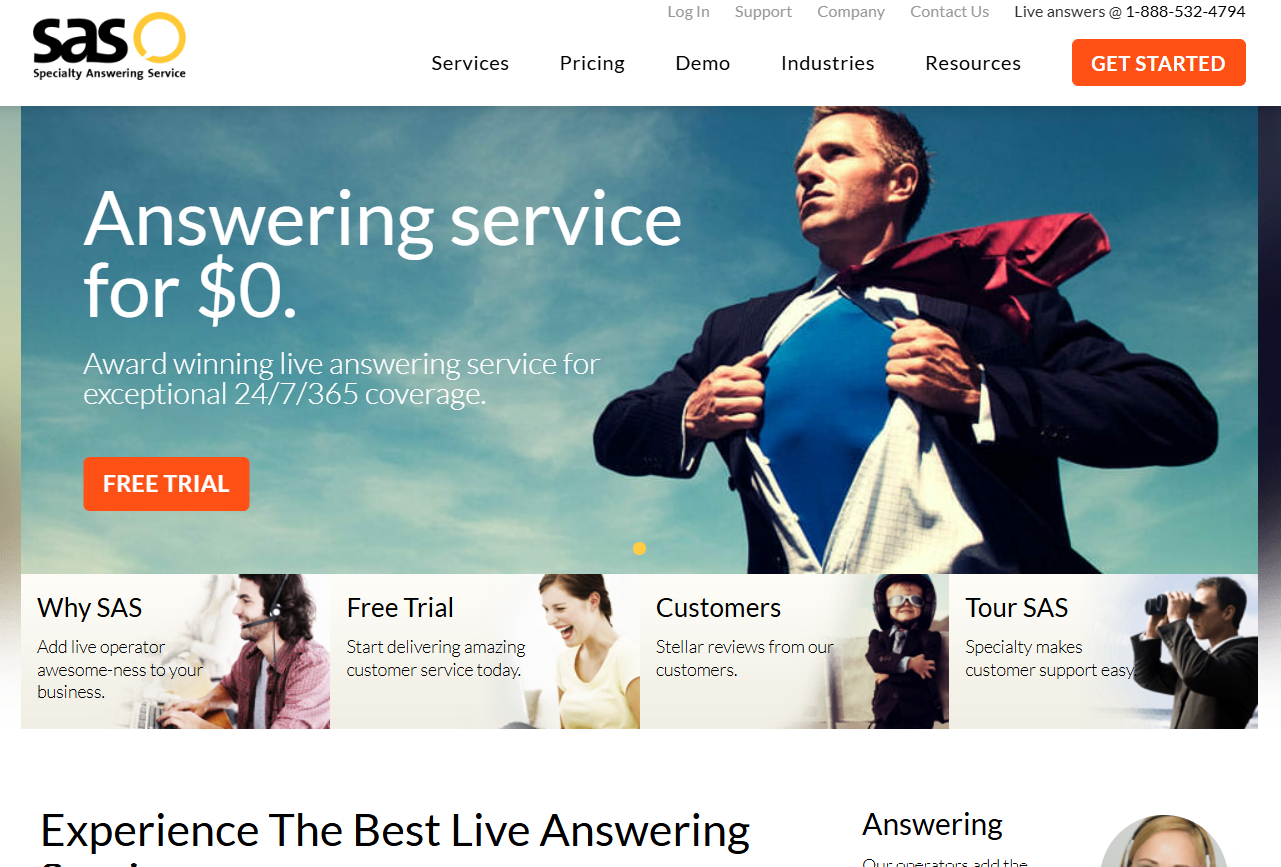
Specialty Answering Service is a long-standing live answering provider with nearly 30 years of experience handling calls for trades, including HVAC. It targets cost-conscious small businesses that want customizable call scripts and 24/7 US-based coverage without enterprise-level pricing.
Key Features:
- 24/7 live answering by US-based operators
- Fully customizable call scripts built through a web-based editor
- On-call schedule management and emergency dispatch support
- Appointment setting and message relay
- Mobile app for reviewing calls and managing interactions on the go
- 14-day free trial with no credit card or setup fee required
- Bilingual answering available
Strengths:
- Real-time script editing without contacting support
- Handles over 30,000 calls per day with high uptime reliability
- Per-second billing (not rounded to the nearest minute) keeps costs slightly more accurate
Limitations:
- Per-minute billing scales with HVAC call volume, creating cost exposure during summer surges
- Integration library and HVAC-specific tooling are limited compared to trade-focused platforms
Pricing Positioning:
- Plans start at $44/month with per-minute and pay-per-call options available
- $159 per month plan for 100 minutes
- Pricing scales by call volume up to $10599 per month for 10,000 Minutes
HVAC Suitability:
- On-call schedule management keeps the HVAC technician dispatch organized
- Custom scripting covers HVAC-specific intake questions
- Free trial is low-risk for testing during off-peak months before committing
5. PATLive
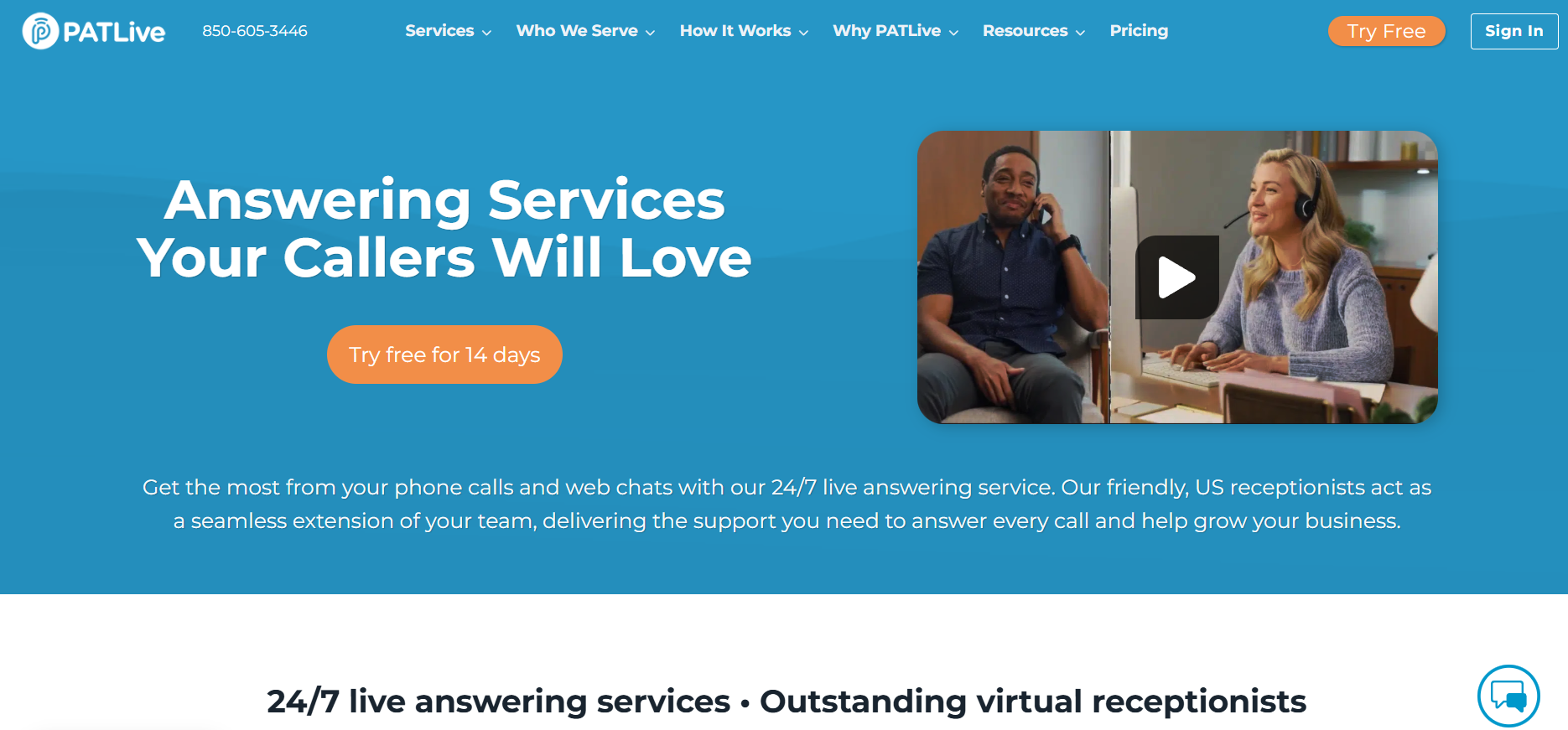
PATLive is a US-based live answering service with over three decades of experience, offering HVAC-specific scripting, emergency dispatch protocols, and bilingual support through 100% domestic receptionists. It positions itself as a personal, relationship-driven alternative to automated services.
Key Features:
- 100% US-based live receptionists available 24/7/365
- HVAC-specific custom scripts and emergency dispatch protocols
- Appointment scheduling via Jobber and Calendly integrations
- Bilingual support available in English and Spanish
- Real-time call updates and message delivery
- 14-day free trial with no contracts required
Strengths:
- Decades of documented HVAC industry experience
- Human receptionists handle the emotional weight of emergency calls reliably
Limitations:
- Per-minute billing climbs during peak HVAC season when call length and volume both increase
- Spanish support is a $20/month add-on, not included by default
Pricing Positioning:
- Pay-as-you-go plan: $75/month
- Starter plan: $250/month (75 minutes)
- Standard: $460/month (200 minutes)
- Premium: $720/month (350 minutes)
- Pro: $1170/month (600 minutes)
- Overage applicable depending on plan tier
HVAC Suitability:
- Emergency HVAC dispatch handling is reliable for after-hours urgent calls
- Jobber and Calendly integrations support core scheduling workflows
- Per-minute costs require close monitoring during summer and winter surge periods
6. MAP Communications

MAP Communications has served home service businesses since 1990, offering live HVAC-trained receptionists with industry-specific terminology knowledge. Its per-minute model has an accessible base price, though HVAC companies with high seasonal volume can see bills shift significantly from month to month.
Key Features:
- 24/7 live answering by HVAC-familiar agents
- Emergency call handling with after-hours and on-call dispatch
- Appointment scheduling and lead capture on every call
- Customizable call scripts with HVAC-specific terminology
- Call reporting and message delivery via email and SMS
- 7-day free trial available
Strengths:
- Low base entry price makes it accessible for small or new HVAC operations
- Agents understand HVAC terminology, reducing miscommunication during intake
- Over three decades of experience handling trade service calls
- No long-term contracts
Limitations:
- Per-minute billing directly penalizes HVAC companies during their highest-volume months
- Integration options are limited compared to newer HVAC-focused platforms
Pricing Positioning:
- Pay as you go: $49/month plus $1.37/minute used
- $179/month for 125 minutes
- $339/month for 250 minutes
- $649/month for 500 minutes
HVAC Suitability:
- HVAC terminology training reduces intake friction common with general answering services
- After-hours emergency dispatch is available, but it depends on agent availability
- Best suited for HVAC contractors with predictable, low-to-moderate call volumes
Traditional vs AI Answering Services for HVAC Contractors
| Parameter | Traditional HVAC Answering Service | AI Answering Service |
|---|---|---|
| Availability | 24/7, with gaps during shift changes or high-demand periods | 24/7/365 with no gaps or staffing-dependent downtime |
| Response Time | Variable; callers may be placed on hold | Instant pickup on every call |
| Simultaneous Call Handling | Limited by active agent count; overflow goes to voicemail | Unlimited concurrent calls |
| Monthly Cost | $140 – $380/month for a 2 – 4 truck operation | $29 – $250/month depending on plan |
| Appointment Booking | Takes a message; office staff calls back to confirm | Books directly into your calendar during the call |
| Call Recording and Transcription | Rarely included; notes are manual | Automatic recording and transcription on every call |
| Emergency Triage | Generic script; accuracy depends on agent’s HVAC familiarity | Trained on your specific triggers (no heat, gas leak, no AC) |
| HVAC Industry Knowledge | Generic scripts; quality varies by provider and agent | Fully customizable to your services, pricing, and terminology |
| Setup Time | Days to weeks; requires scripting and agent onboarding | Minutes to hours; pulls from your existing business information |
| Scalability | Requires hiring, training, and increased contract spend | Scales instantly at no additional cost |
| Multilingual Support | Bilingual agents at a higher tier or with an added cost | Multiple languages are included on most standard plans |
| Data Ownership | Call logs held by the provider; limited access | Full call history and transcripts stored in your account |
What to Look for When Choosing an HVAC Answering Service
The best answering service for HVAC companies does more than answer phones. It handles emergency dispatch, syncs with your scheduling system, and scales with seasonal demand. You can start by evaluating your operational needs across four areas that are mentioned below:
Identify Your Core Operational Needs
- Coverage Type: Decide if you need a 24/7 HVAC answering service for after-hours emergencies or overflow support during peak seasons only.
- Call Handling Scope: Confirm whether your HVAC phone answering service should take messages, route dispatches, or book appointments directly into your calendar.
Prioritize HVAC-Specific Features
- Software Integration: Your HVAC dispatch answering service must sync with your scheduling platform to trigger technician alerts and keep customer records current.
- Emergency Triage: The service should separate a genuine emergency from a routine request.
- Bilingual Support: Multilingual HVAC customer service answering captures leads your competitors miss.
Evaluate Agent Quality and Technology
- Live Agents vs. AI: A live answering service for HVAC contractors suits complex calls, while an AI answering service for HVAC companies handles routine booking and after-hours intake.
- Custom Scripting: Your HVAC virtual receptionist should use scripts tailored to your business so callers never realize they have reached an outside service.
Compare Pricing Structures
- Billing Model: HVAC call answering services typically charge per minute, per call, or at a flat monthly rate. You should choose based on your call volume.
- Seasonal Flexibility: Verify your provider allows plan scaling during winter and summer peaks without penalty fees.
Final Verdict
An HVAC business runs on technician time, and every call your team fields directly is time pulled away from billable work. The services reviewed here exist to close that gap, but they do it differently enough that the wrong pick creates its own operational drag.
Goodcall handles intake, triage, and scheduling without pulling anyone off a job. Set it up in minutes, connect it to your existing scheduling tools, and start a 14-day free trial before your next busy period hits.
FAQs
What is the best answering service for HVAC companies?
The best answering service for HVAC companies includes Goodcall (AI voice automation and dispatch), AnswerForce (live HVAC receptionists), Smith.ai (hybrid AI and live agents), and Specialty Answering Service (high-volume, flexible call handling).
How does an HVAC answering service work?
An HVAC answering service receives your inbound calls through live agents or an AI-powered HVAC virtual receptionist, collects caller details, triages urgency, and either books the appointment or routes the call to your on-call technician.
Can AI answer emergency HVAC calls?
Yes. An AI answering service for HVAC companies can detect emergency language like "no heat" or "carbon monoxide alarm," flag the call as urgent, and immediately connect the caller to your on-call technician.
Do HVAC answering services schedule appointments?
Yes. Most HVAC phone answering services connect directly to your scheduling calendar, book appointments in real time, and send confirmation messages to both the customer and your technician during the same call.
Are HVAC answering services available 24/7?
Yes. HVAC answering services run around the clock, so a furnace failure at midnight gets answered the same way a noon call does. That kind of consistent availability is exactly what separates the best answering service for HVAC companies from a basic voicemail setup.