Most businesses think they are available when customers call. The numbers say otherwise.
According to a 2024 study by 411 Locals, businesses answer only 37.8% of inbound calls on average. Another67% of callers who reach voicemail never leave a message. They just call someone else.
Understanding the types of answering services available is the first step toward making sure that business is still yours.
What a Business Answering Service Is and What It Costs You to Ignore One
A business answering service handles inbound customer calls when your team is unavailable, occupied, or offline.
Customers call when it suits them. A call answering service makes sure someone is always there when they do.
Here is what it immediately improves:
Response speed when your team is at capacity
Missed call rate during peak hours and outside business hours
Caller experience regardless of the time or day
When there is no system in place to catch those calls the cost becomes very real very fast:
Appointment slots go unfilled because callers did not bother leaving a voicemail
Leads go to a competitor who simply answered first
Revenue is lost without you ever knowing a call came in
Most businesses rely on a phone answering service to handle exactly these situations:
Capture inbound leads before callers move on to someone else
Schedule appointments without staff needing to manage every call manually
Answer routine questions without pulling the team away from active work
Route urgent calls to the right person based on what the caller actually needs
Cover after-hours demand without the expense of overnight staffing
Businesses in healthcare, home services, hospitality, legal, and real estate all share the same challenge.
Customers expect a professional response every time they call regardless of when that call comes in. A reliable phone answering service is what makes that possible consistently.
Every Type of Answering Service and What Each One Is Actually Good At
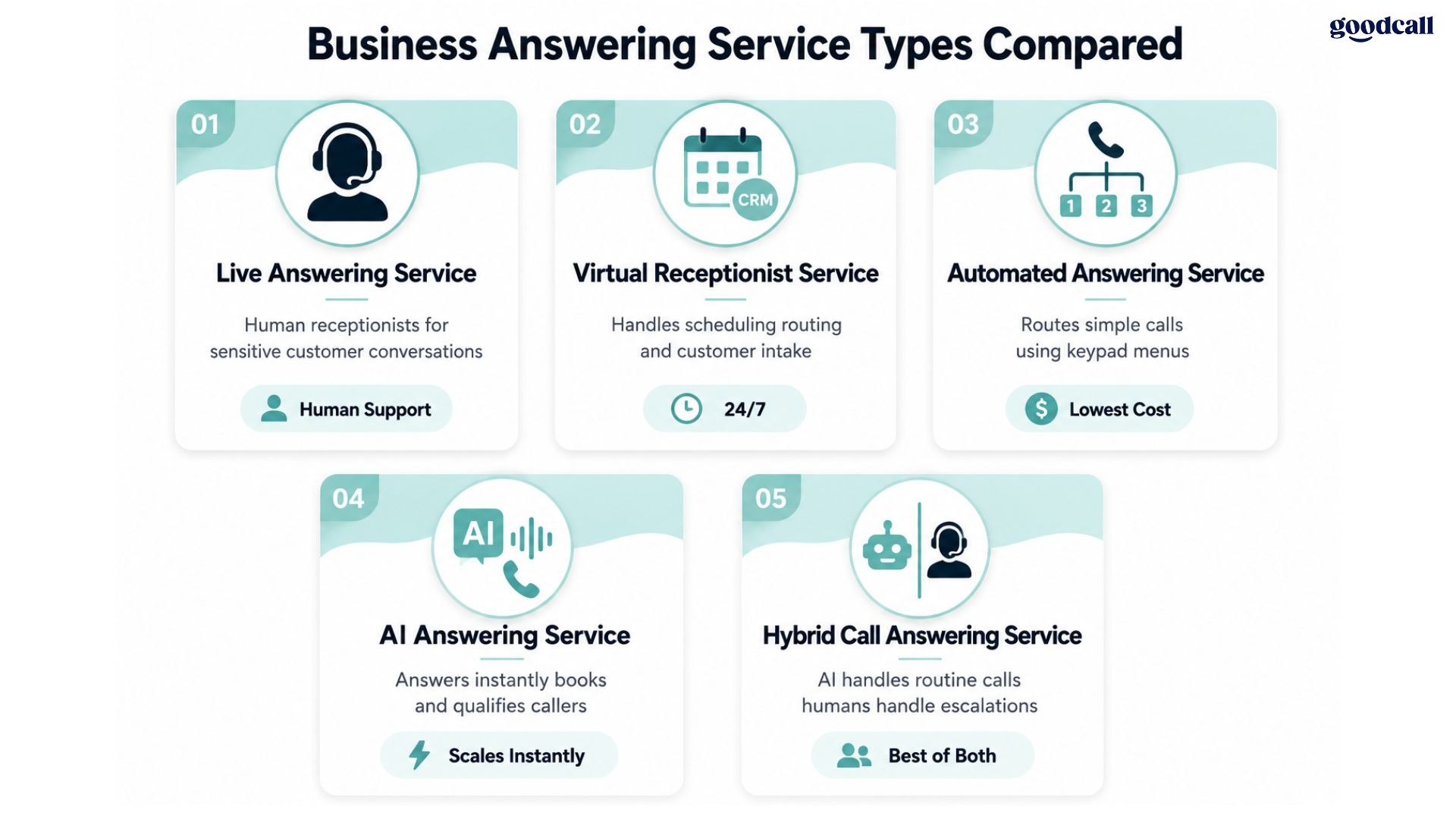
No single answering service fits every business. The five main types differ in cost, capability, and the kind of callers they handle best.
Here is what each one does and where each one has its limits.
Live Answering Service
A live answering service connects callers to a trained human receptionist who handles scheduling, message taking, call routing, and general support.
Best suited to medical offices, legal firms, and any business where the caller's emotional state matters
Costs $300 to $1,000 or more per month depending on call volume and coverage hours
Human empathy and judgment on every call is the defining advantage
When call volume spikes the service slows down. Consistency across agents becomes harder to maintain as demand increases.
Virtual Receptionist Service
A virtual receptionist service goes further than basic call answering. These services manage appointment booking, calendar updates, CRM entries, and customer intake processes on behalf of your business.
Best for service businesses, consultants, real estate companies, and multi-location operations
Costs $200 to $800 or more per month depending on the features included
Offers a broader level of operational support than a standard answering service
The core limitation remains staffing. When demand surges human availability creates gaps that the service cannot always fill in time.
Automated Answering Service
An automated answering service routes callers through pre-programmed phone menus. Callers select options using their keypad and are directed accordingly without speaking to anyone.
Best for large organisations with high call volume and straightforward predictable routing needs
Costs $50 to $200 per month
Handles simple call flows faster and at lower cost than any live alternative
The weakness is the caller experience itself. Lengthy or confusing menu options push callers away and a caller who gives up is usually a customer you will not get back.
AI Answering Service
An AI phone answering service holds natural spoken conversations with callers using conversational AI. There are no menu trees to navigate and no hold queues to sit through.
This is the category that has evolved the most significantly over the last two years.
A modern AI answering service can:
Answer every call instantly with no delays or voicemail fallback
Gather caller details, service requirements, and urgency level in real time
Book appointments and update your calendar before the call ends
Direct complex calls to the right team member based on what the caller says
Respond to frequently asked questions without involving your staff
Operate as a full 24/7 answering service at a flat monthly rate with no overtime
At a glance:
Best for home services, healthcare, hospitality, and businesses with high repetitive call volume
Costs $49 to $299 per month for most small businesses
Resolves 90 to 95% of calls without any human involvement
AI is the only model that absorbs increased call volume instantly without additional hiring or cost.
Hybrid Call Answering Service
A hybrid call answering service pairs AI automation with live agent support. AI takes care of routine and repetitive calls while human agents handle escalations, complex situations, and conversations that require more careful judgment.
Best for growing businesses with a wide range of inquiry types and variable call volumes
Costs $200 to $600 or more per month
Combines the efficiency of AI with the flexibility of human support
The main trade-off is a higher monthly cost and more involved setup compared to an AI-only system.
The right phone answering service is ultimately the one that handles your most valuable callers well and makes sure no call goes unanswered when your team cannot get to it.
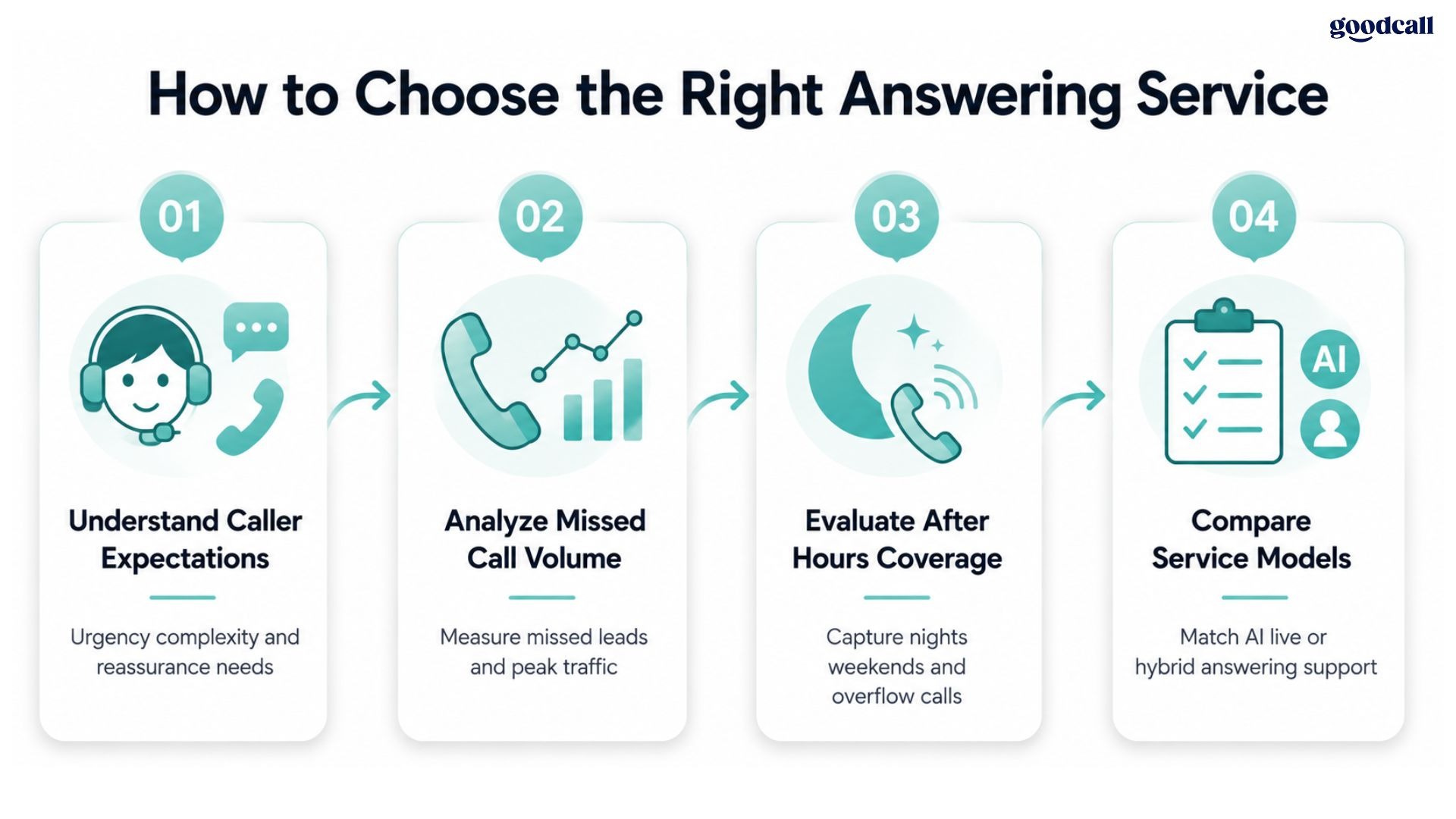
How to Choose the Right Call Answering Service for Your Business
Many businesses choose an answering service based on monthly cost alone. The real cost only becomes visible later when a high-value lead calls at 8 PM on a Friday and reaches voicemail.
Choosing the right call answering service comes down to understanding how your callers behave and what they expect when they reach you.
Start with what your callers actually expect
A homeowner calling about a burst pipe, a guest trying to book a last-minute hotel stay, and a patient calling a medical practice after hours all share one expectation: they want someone to answer now.
Businesses where a missed call directly means lost revenue need AI-powered or automated support
Businesses where callers need reassurance and nuance are better served by a live or hybrid model
Businesses that receive mostly routine and predictable calls are well suited to an AI or automated system
Understand your real call volume
The more useful question is not how many calls you receive but how many you are currently missing.
High inbound call volume suits an AI answering service platform or a hybrid system
Steady and predictable volume is well matched to a virtual receptionist service
Lower volume with more complex caller needs often suits a live answering service setup
Decide how important after-hours coverage is
A 24/7 answering service is the only model that covers every hour of the day without requiring overnight staffing.
Research shows after-hours calls account for 30 to 40% of missed leads for many businesses
An AI answering service covers those calls at the same flat monthly rate as daytime hours
Live services typically apply premium rates for evening, weekend, and holiday coverage
Factor in the real cost of doing nothing
The monthly subscription cost of an answering service is easy to see. The cost of not having one is harder to measure but far larger.
Dialzara's pricing research estimates that each missed call costs a business approximately $1,200 in lost revenue on average.
An AI answering service at $49 to $249 per month recovers its cost with a single captured lead
A live service at $300 to $1,000 per month requires a higher volume of conversions to justify the spend
A full-time in-house receptionist at $35,000 to $60,000 per year carries the highest break-even threshold
Why Businesses Are Quietly Moving to AI Answering Services
AI answering services were once seen as an emerging option worth watching. They are now the practical default for businesses that cannot afford to keep losing calls.
The shift has happened gradually and without much fanfare. It has been driven by results rather than hype.
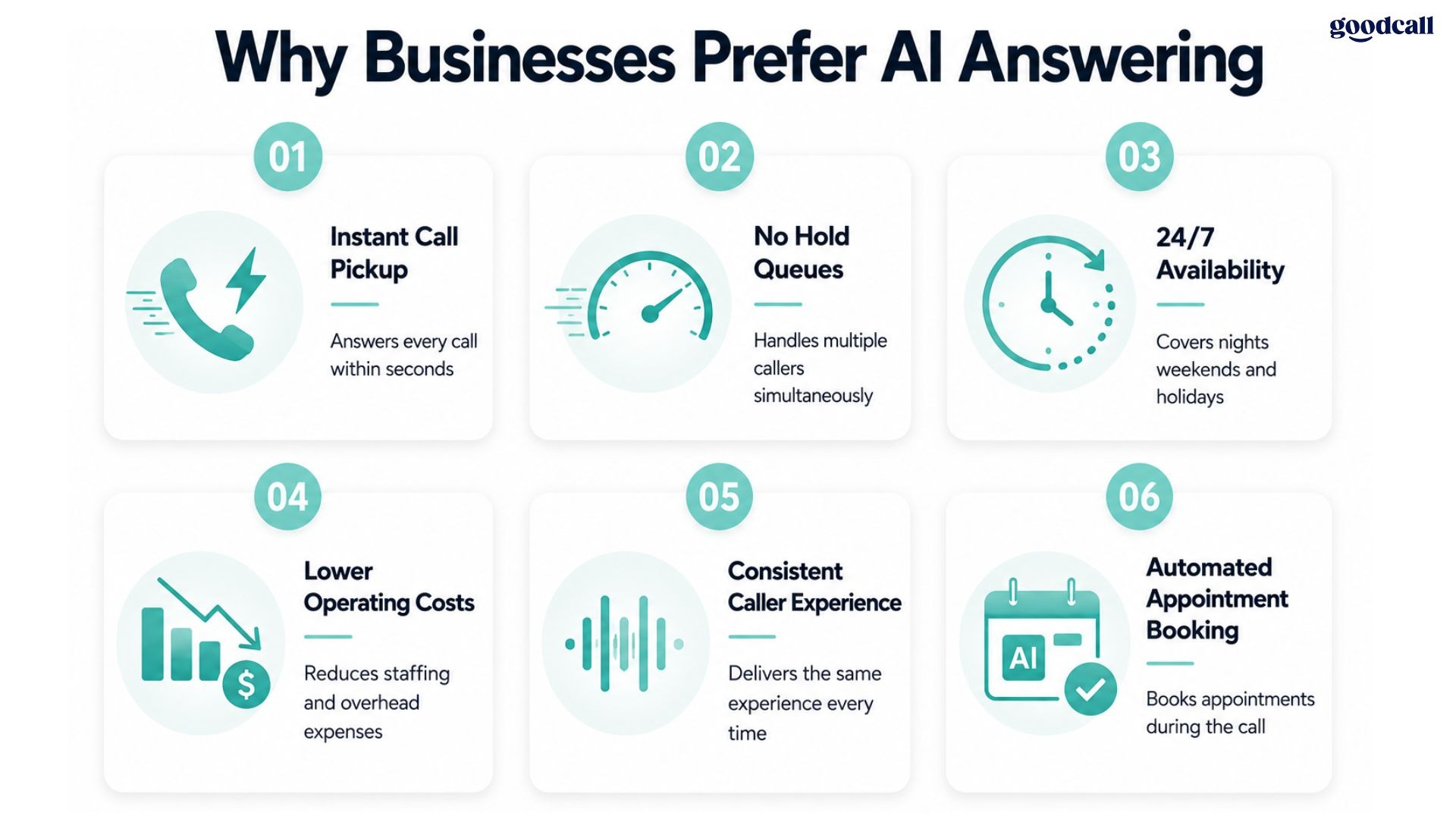
AI answers every call immediately
Live services put callers on hold. Automated menus make callers work for a response. An AI phone answering service picks up in under five seconds every time regardless of how many calls arrive at once.
During peak periods that reliability is what separates a captured lead from a lost one.
No hold queues when call volume spikes
No drop in quality when multiple calls arrive simultaneously
No voicemail fallback when the team is unavailable
AI scales without additional staffing
Adding staff to handle call volume takes time and money. AI absorbs increased demand immediately without any of the costs associated with hiring, training, or scheduling.
Manages high-volume periods and quieter periods with equal consistency
Provides full coverage on evenings, weekends, and public holidays as part of a flat-rate 24/7 answering service
Removes the variability in caller experience that comes with a rotating team of human staff
AI produces outcomes that show up in the business
NextPhone's research on AI call handling found that businesses using AI answering services resolve 90 to 95% of calls without human assistance and maintain 99% positive caller sentiment.
Those are operational results that directly affect revenue and customer retention.
What Goodcall Does and Why It Works Better Than You Might Expect
Most answering services are built to handle calls in a general sense. Goodcall is built for businesses where an unanswered call has a direct cost attached to it.
The distinction shows up not just in answering calls but in what happens during and after each one.
Goodcall qualifies the caller, routes the call appropriately, and books the appointment before your team ever needs to get involved.
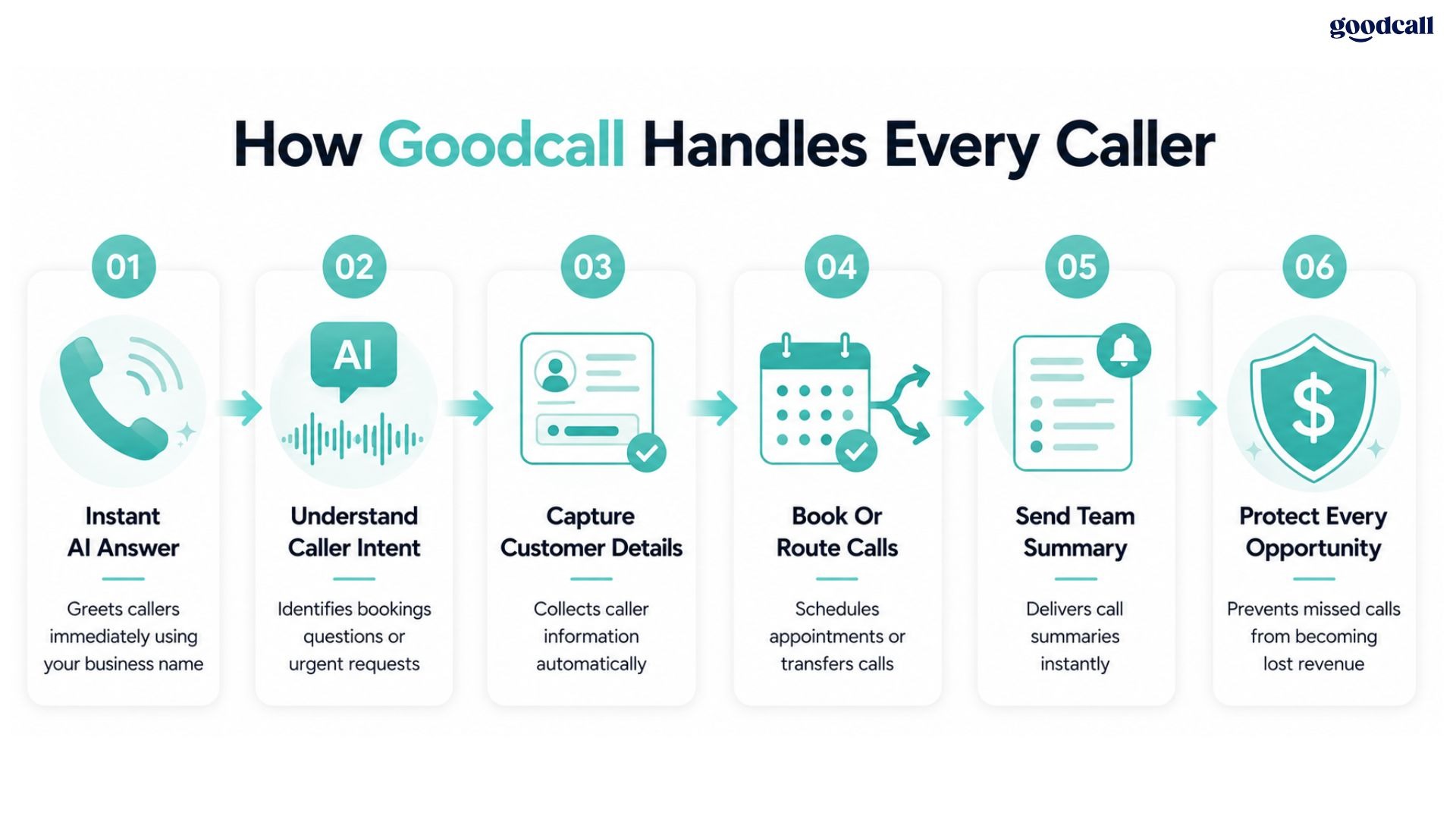
What happens on every inbound call:
Goodcall answers immediately using your business name and a script tailored to your operation
It determines what the caller needs whether that is a booking, an urgent request, a pricing question, or general information
It collects the caller's details, service type, and urgency level automatically during the conversation
It completes the booking or routes the call based on the workflow you have set up
It sends a full call summary to your team so nothing requires follow-up chasing
What that means for your business day to day:
Calls that previously ended in voicemail after hours now result in confirmed bookings
Your team focuses on delivering work rather than managing the phone
High-demand periods and marketing campaigns no longer overwhelm your front-line communication
Every caller gets the same professional experience whether your team is on the job or off the clock
Verified Pricing:
$41 per month billed annually
$59 per month on a rolling monthly basis
No per-call or per-minute charges at any volume
14-day free trial with no credit card required to start
The right answering service is not the least expensive one on the list. It is the one that picks up when your team cannot and turns that call into a booked job or confirmed appointment.
Every type of answering service covered in this guide solves a real business problem. The one that fits yours depends on your call volume, your callers, and what it actually costs your business when a call goes unanswered.
If you are ready to stop losing revenue to missed calls see how Goodcall works and start your 14-day free trial today.
FAQs
What are the main types of answering services?
The main types of answering services are live answering services, virtual receptionist services, automated answering services, AI answering services, and hybrid systems that combine AI automation with live agent support for more complex calls.
Are AI answering services better than live receptionists?
For most businesses yes. An AI answering service delivers faster response times, full 24/7 coverage, and costs significantly less than a live alternative. Live receptionists remain the better choice for calls that involve sensitive situations or require experienced human judgment.
How much does an answering service cost?
An AI answering service starts at around $49 per month for most small businesses. A live answering service typically costs between $300 and $1,000 or more per month. A full-time in-house receptionist costs between $35,000 and $60,000 per year before factoring in benefits and management time.
Can AI answering services answer calls 24/7?
Yes. An AI answering service operates continuously including evenings, weekends, and public holidays at no additional charge. It handles multiple simultaneous calls during busy periods without placing any caller on hold.
Can AI answering services schedule appointments?
Yes. Most AI answering service platforms connect directly with Google Calendar, scheduling tools, and booking systems to confirm appointments in real time during the call. No manual follow-up or callback from your team is required.
Explore Goodcall For Free
Try Goodcall's AI Phone Assistants Free for the first 14 days!