

Deepgram Alternatives
.jpg)
If your business depends on voice data, every millisecond and every misheard word can cost you money. From powering AI assistants to analyzing customer support calls, speech recognition has become mission-critical infrastructure. While Deepgram has built a strong reputation in the speech-to-text space, the need for a capable Deepgram alternative becomes clear as businesses seek greater scalability, pricing transparency, and customization options.
This article examines the leading Deepgram competitors, compares their strengths, pricing models, and enterprise readiness, and explains when switching makes strategic sense.
What to Look for in a Deepgram Alternative
When evaluating Deepgram Alternatives, businesses should compare these critical factors before selecting among Deepgram competitors and speech-to-text API alternatives:
- Accuracy: Choose providers with low word error rates, domain-specific language models, multilingual support, and proven benchmarks validated by independent testing frameworks.
- Performance: Assess processing speed, audio handling quality, noise robustness, speaker diarization, and consistency across different accents and real-world call environments.
- Latency: For real-time speech-recognition API use cases, ensure sub-second response times, streaming support, and interruption handling for conversational-AI voice solutions.
- Compliance and Security: Verify HIPAA readiness, SOC 2 certification, encryption standards, data retention policies, and transparent documentation aligned with US regulatory requirements.
- Pricing: Conduct a speech-to-text pricing comparison, including per-minute rates, streaming premiums, storage fees, and enterprise contract flexibility.
- Scalability: Ensure the platform can handle high call volumes, global traffic spikes, and enterprise deployments without degrading performance.
- Support: Evaluate onboarding assistance, dedicated account management, SLA guarantees, documentation quality, and long-term enterprise support options.
Top Deepgram Alternatives for Speech-to-Text & Voice AI
Below are the leading Deepgram competitors for voice AI and speech-to-text API:
- AssemblyAI: Developer-focused AI transcription API with strong NLP add-ons.
- Goodcall: Complete voice AI platform for call automation and business workflows.
- OpenAI Whisper: Open-source speech recognition model optimized for flexibility.
- Google Cloud Speech-to-Text: Enterprise-grade speech recognition with global infrastructure.
- Rev AI: Hybrid AI + human transcription accuracy model.
- Microsoft Azure Speech: Integrated real-time speech recognition API within the Azure ecosystem.
- Amazon Transcribe: AWS-native transcription service for cloud-native workloads.
- Speechmatics: High-accuracy multilingual speech recognition engine.
1. AssemblyAI
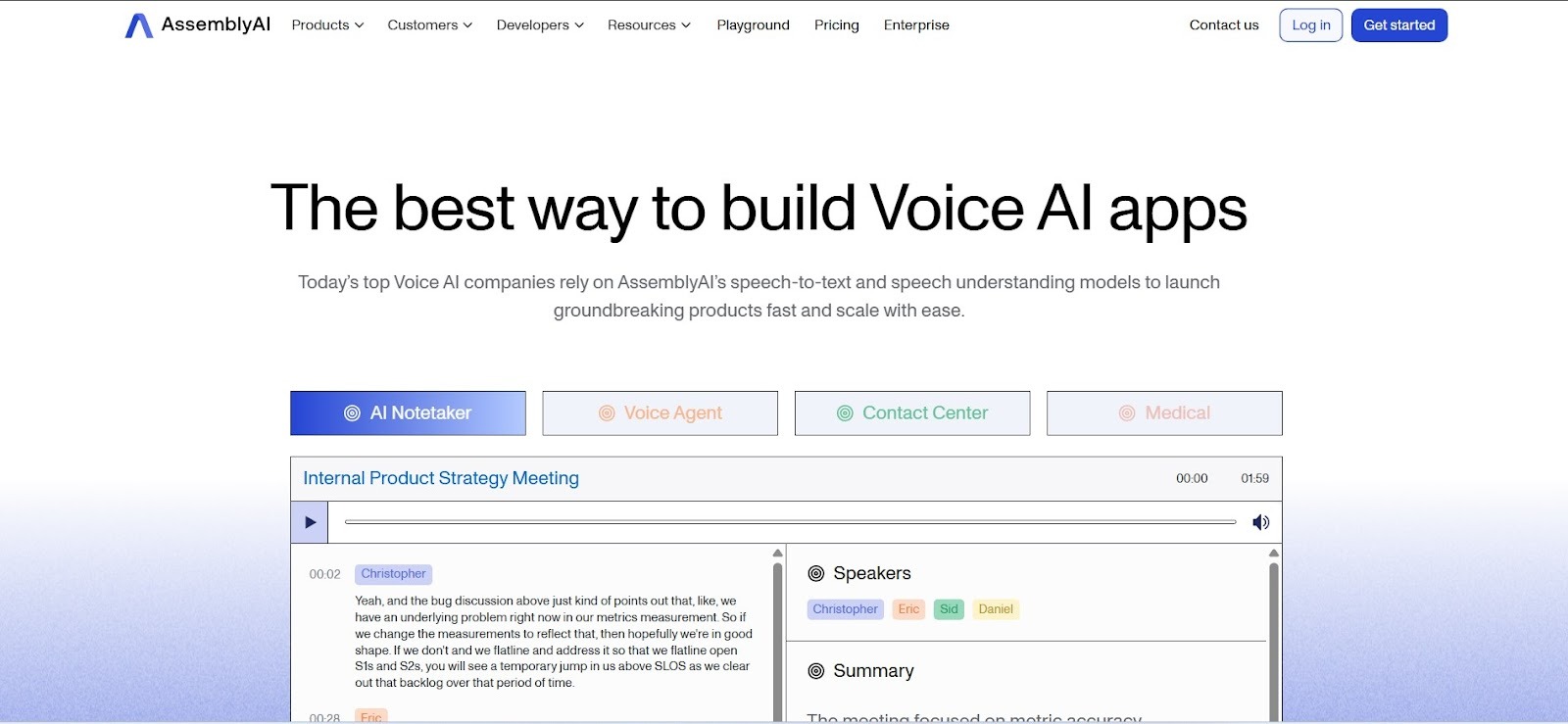
AssemblyAI is a powerful AI transcription API with strong NLP and speech recognition capabilities, ideal for developers building scalable applications requiring accurate real-time and batch processing.
Best for: Developers building custom speech-to-text applications and AI-driven products.
Key features:
- Real-time speech-to-text API
- Speaker diarization
- Sentiment analysis
- Topic detection
- Custom vocabularies
Pros:
- Easy developer onboarding and SDK support
- Built-in NLP insights
- Strong accuracy for diverse audio types
Cons:
- Limited full conversational AI voice solutions
- Pricing can increase with heavy usage
Pricing overview: Usage-based pricing per minute of audio processed with volume discounts at higher tiers.
2. Goodcall
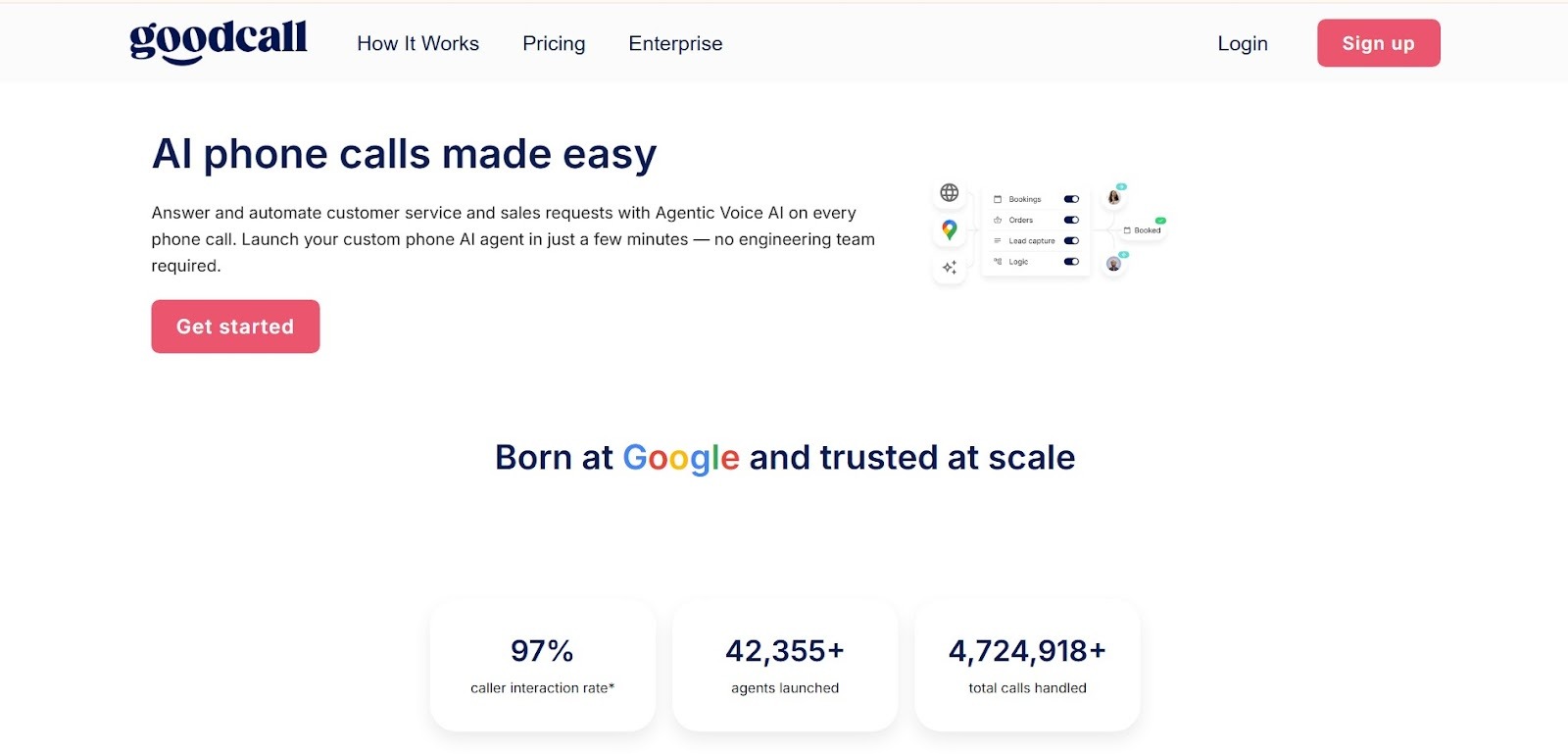
Goodcall is a comprehensive voice AI platform that combines speech recognition, automation, and business workflows for enterprise call handling.
Best for: Businesses seeking complete conversational AI voice solutions beyond standard transcription.
Key features:
- Conversational AI workflows
- Call automation and routing
- CRM and database integrations
- Real-time analytics
Pros:
- End-to-end voice automation capabilities
- Designed for enterprise-scale deployments
- Supports complex business workflows
Cons:
- Not purely a speech-to-text API
- Custom implementation may be required
Pricing overview: Custom enterprise pricing based on call volume, features, and support requirements.
3. OpenAI Whisper
OpenAI Whisper is an open-source speech recognition model designed for multilingual transcription and translation. It supports offline deployment and flexible customization, making it suitable for developers seeking adaptable speech to text API alternatives.
Best for: Engineering teams building custom transcription systems or deploying on self-managed infrastructure.
Key features:
- Multilingual speech recognition
- Open-source model access
- Noise-robust transcription
- Offline processing capability
Pros:
- No licensing fees
- Highly customizable
- Strong multilingual performance
Cons:
- Requires infrastructure management
- No built-in enterprise SLAs or compliance guarantees
Pricing overview: Free model usage; infrastructure, hosting, and compute costs depend on deployment environment.
4. Google Cloud Speech-to-Text
Google Cloud Speech-to-Text is an enterprise-grade AI transcription API offering real-time and batch processing with advanced model adaptation. It integrates deeply within Google Cloud, supporting scalable enterprise voice AI solutions.
Best for: Large enterprises requiring high scalability, compliance alignment, and cloud-native integration.
Key features:
- Real-time speech recognition API
- Custom model adaptation
- Automatic punctuation and diarization
- Multi-language support
Pros:
- Enterprise scalability
- Strong compliance framework
- Seamless Google Cloud integration
Cons:
- Complex pricing tiers
- Potential vendor lock-in
Pricing overview: Usage-based pricing per audio minute with separate rates for standard and enhanced models.
5. Rev AI
Rev AI combines fast automated speech recognition with optional human-verified accuracy, making it ideal for media and compliance workflows. It offers scalable solutions that balance speed and quality for diverse use cases.
Best for: Organizations needing hybrid AI plus human transcription accuracy.
Key features:
- Automated speech recognition API
- Optional human review
- Speaker diarization
- Custom vocabulary support
Pros:
- High accuracy with human-assisted option
- Easy API integration
- Good for compliance and media workflows
Cons:
- Human-assisted service increases costs
- Less suited to real-time streaming focus
Pricing overview: Usage-based pricing per minute; optional human review adds additional per-minute charges.
6. Microsoft Azure Speech
Microsoft Azure Speech offers robust real-time and batch transcription with advanced customization and translation features within the Azure ecosystem. It supports enterprise compliance and deep integration with productivity tools.
Best for: Enterprises relying on Microsoft cloud services and integrated AI capabilities.
Key features:
- Real-time speech recognition API
- Custom speech models
- Speech translation
- Azure ecosystem integrations
Pros:
- Strong security and compliance
- Enterprise scalability
- Broad language support
Cons:
- Complex pricing
- Dependency on Microsoft stack
Pricing overview: Usage-based per audio minute with tiered enterprise plans and custom agreements.
7. Amazon Transcribe
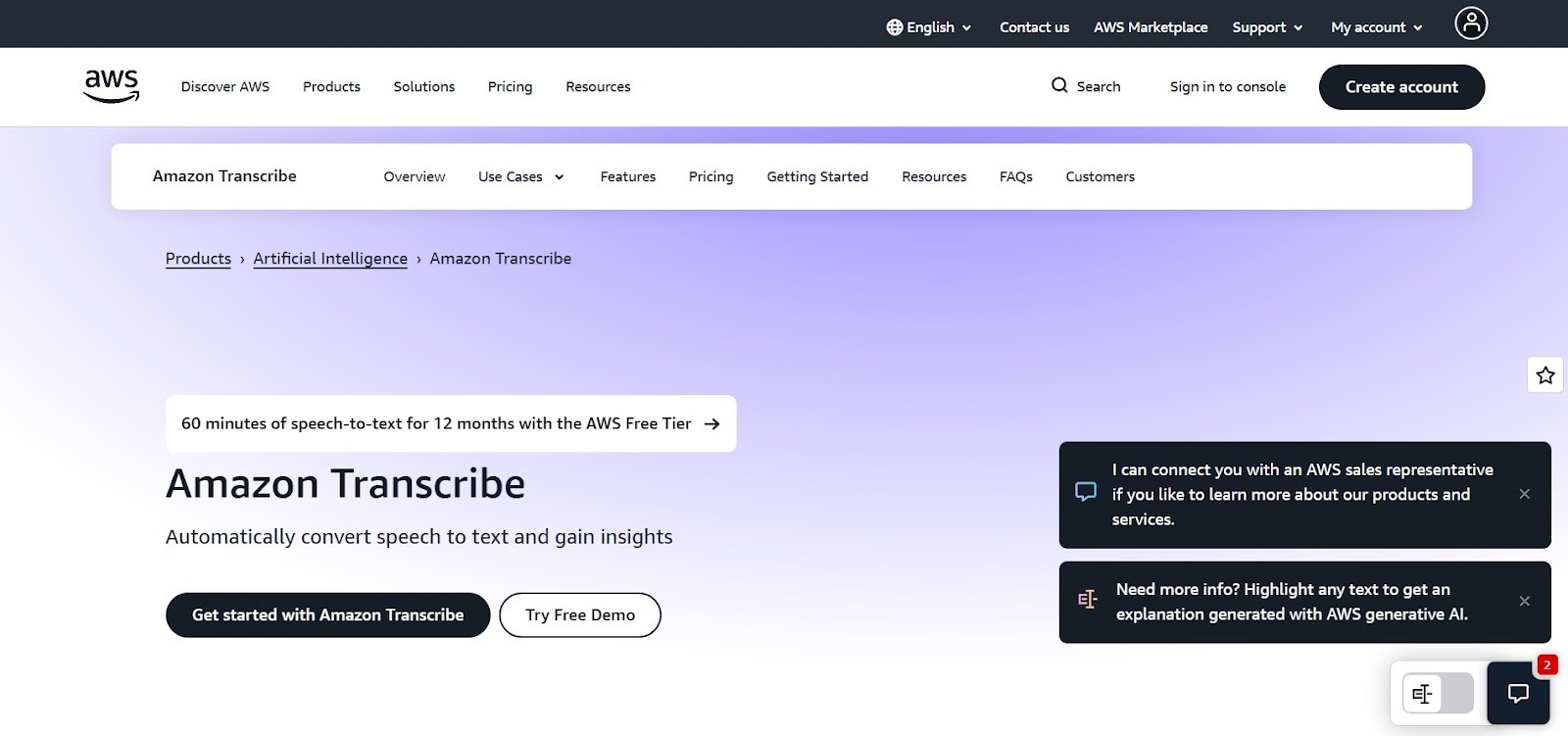
Amazon Transcribe is a cloud-native speech recognition service within AWS, providing real-time and batch transcription with features optimized for analytics and call logs. It’s tailored for scalable workloads in AWS environments.
Best for: Businesses embedded in the AWS ecosystem seeking scalable, reliable speech recognition.
Key features:
- Real-time and batch transcription
- Custom vocabulary
- Speaker identification
- Call analytics integration
Pros:
- Seamless AWS integration
Scales with enterprise workloads - HIPAA eligibility through AWS compliance programs
Cons:
- Costs scale with usage
- Requires AWS infrastructure familiarity
Pricing overview: Pay-as-you-go pricing per second of audio processed, with tiered volume discounts available.
8. Speechmatics
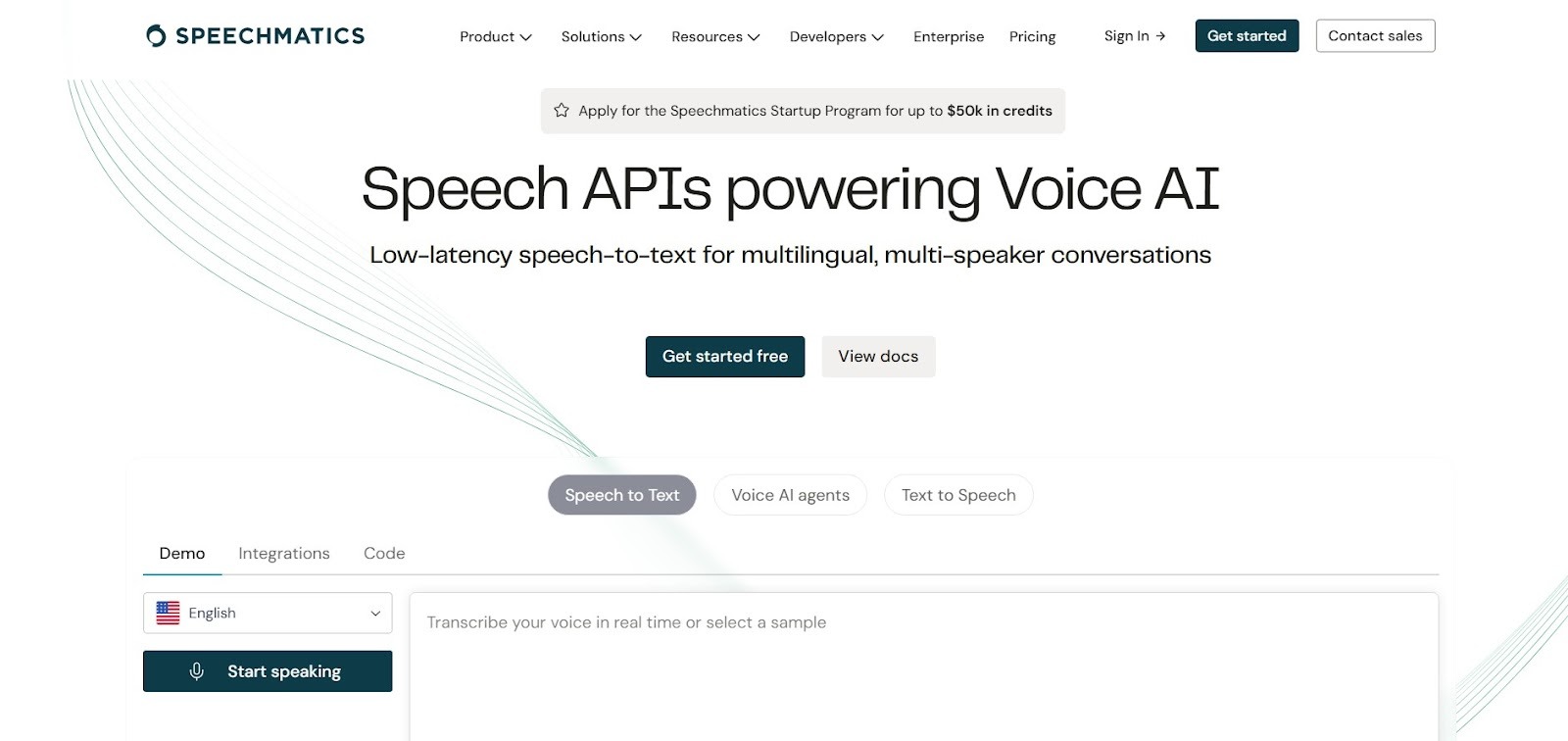
Speechmatics delivers high-accuracy, language-agnostic speech recognition with strong global language support. It suits enterprises and global teams requiring consistent performance across diverse audio sources.
Best for: Businesses needing robust multilingual transcription and flexible deployment options.
Key features:
- Multilingual speech recognition
- On-premise and cloud deployment
- Custom language models
- Real-time API support
Pros:
- Excellent language coverage
- Flexible deployment choices
- Strong accuracy across domains
Cons:
- Less comprehensive voice AI workflows
- Enterprise support varies by plan
Pricing overview: Usage-based pricing with options for subscription or enterprise-level agreements.
When Does It Make Sense to Switch from Deepgram?
Not every organization needs to move away from Deepgram. However, certain operational, financial, or strategic shifts may justify evaluating Deepgram Alternatives. Switching decisions should align with long-term infrastructure, compliance, and automation goals.
Here are the scenarios in which businesses commonly consider Deepgram competitor:
- Rising Costs at Scale
Usage-based pricing can increase significantly with high transcription volumes. Enterprises often conduct a speech-to-text pricing comparison to secure predictable long-term contracts.
- Need for Full Voice Automation
Deepgram primarily focuses on transcription capabilities. Companies building conversational AI voice solutions may require full voice AI platforms for businesses with workflow automation.
- Enterprise Compliance Requirements
Regulated industries must meet HIPAA, SOC 2, and strict data governance standards. If compliance documentation or contractual agreements fall short, switching becomes necessary.
- Cloud Ecosystem Consolidation
Organizations standardizing on AWS, Azure, or Google Cloud often prefer native speech services. Consolidation improves security management, billing efficiency, and infrastructure control.
- Advanced Customization Needs
Some use cases require domain-specific language modeling or on-premise deployment. Open-source or highly customizable speech recognition providers may offer greater flexibility than managed APIs.
- Scalability and Global Expansion
Rapid growth demands reliable global infrastructure and consistent performance. Enterprises may switch to providers offering stronger international support and enterprise voice AI solutions.
How to Migrate from Deepgram to Another Speech-to-Text API
Migrating between Deepgram alternatives requires technical planning and operational validation. Here’s how you can migrate to another platform:
Step 1: Benchmark Accuracy
Run parallel testing between Deepgram and the new provider. Measure:
- Word error rate
- Real-time latency
- Speaker diarization quality
- Domain vocabulary handling
Step 2: Review API Compatibility
Compare:
- Streaming endpoints
- Authentication methods
- SDK availability
- Webhook behavior
Many speech-to-text API alternatives use REST-based architectures, simplifying integration updates.
Step 3: Update Infrastructure and Cloud Dependencies
Assess how the new provider integrates with storage, event systems, and compute services. Cloud-native options like AWS, Azure, or Google may require infrastructure alignment.
Step 4: Validate Security and Compliance
Confirm:
- Encryption standards
- Data retention policies
- Regulatory alignment
Healthcare and financial organizations should verify HIPAA readiness and the adequacy of contractual protections.
Step 5: Phased Rollout
Deploy in stages:
- Internal testing
- Limited production traffic
- Full cutover
This reduces risk during API replacement.
Step 6: Monitor Post-Migration Performance
Track accuracy, latency, system uptime, and customer experience metrics. Continuous monitoring ensures the selected Deepgram Alternatives deliver long-term reliability.
Conclusion: Which Deepgram Alternative Is Right for You?
Choosing among Deepgram Alternatives depends on infrastructure, scale, and long-term AI strategy. Developers building custom applications often prefer AssemblyAI or Whisper for flexibility and control. Enterprises typically select Google Cloud Speech-to-Text or Microsoft Azure Speech for compliance, scalability, and ecosystem alignment.
AWS-native organizations benefit from Amazon Transcribe’s seamless integration and governance simplicity. Businesses seeking complete conversational AI voice solutions, automation, and workflow orchestration should consider Goodcall as a full-service voice AI platform rather than a standalone transcription API.
Ready to move beyond basic transcription? Get in touch with Goodcall to discover how a complete voice AI platform can automate calls, streamline workflows, and drive measurable business outcomes.
FAQs
What is the best alternative to Deepgram?
The best alternative depends on the use case. Developers often choose AssemblyAI or Whisper, enterprises prefer Google or Azure, and businesses seeking a complete voice AI solution consider Goodcall.
Is there a cheaper alternative to Deepgram?
Open-source models like Whisper reduce licensing costs but require infrastructure management. Cloud providers may offer lower enterprise pricing at scale through negotiated contracts.
Which speech-to-text API has the best accuracy?
Accuracy varies by domain and dataset. Enterprise providers like Google and Microsoft invest heavily in model training and benchmarking, often delivering competitive word error rates.
Are Deepgram alternatives HIPAA compliant?
Some providers support HIPAA under Business Associate Agreements.
Healthcare organizations should verify compliance documentation directly with vendors and review HHS guidelines.
What is the difference between speech-to-text and voice AI?
Speech-to-text converts audio into text. Voice AI adds intent recognition, conversation flow, and automation, enabling conversational AI voice solutions and call workflows.
Can I build a call automation system without Deepgram?
Yes. Businesses can combine speech-to-text APIs with conversational AI platforms to automate call handling, routing, and AI-driven customer interactions.
Is Deepgram good for enterprise use?
Deepgram supports enterprise use cases. However, large organizations often evaluate Deepgram competitors based on ecosystem alignment, compliance, and pricing structure.