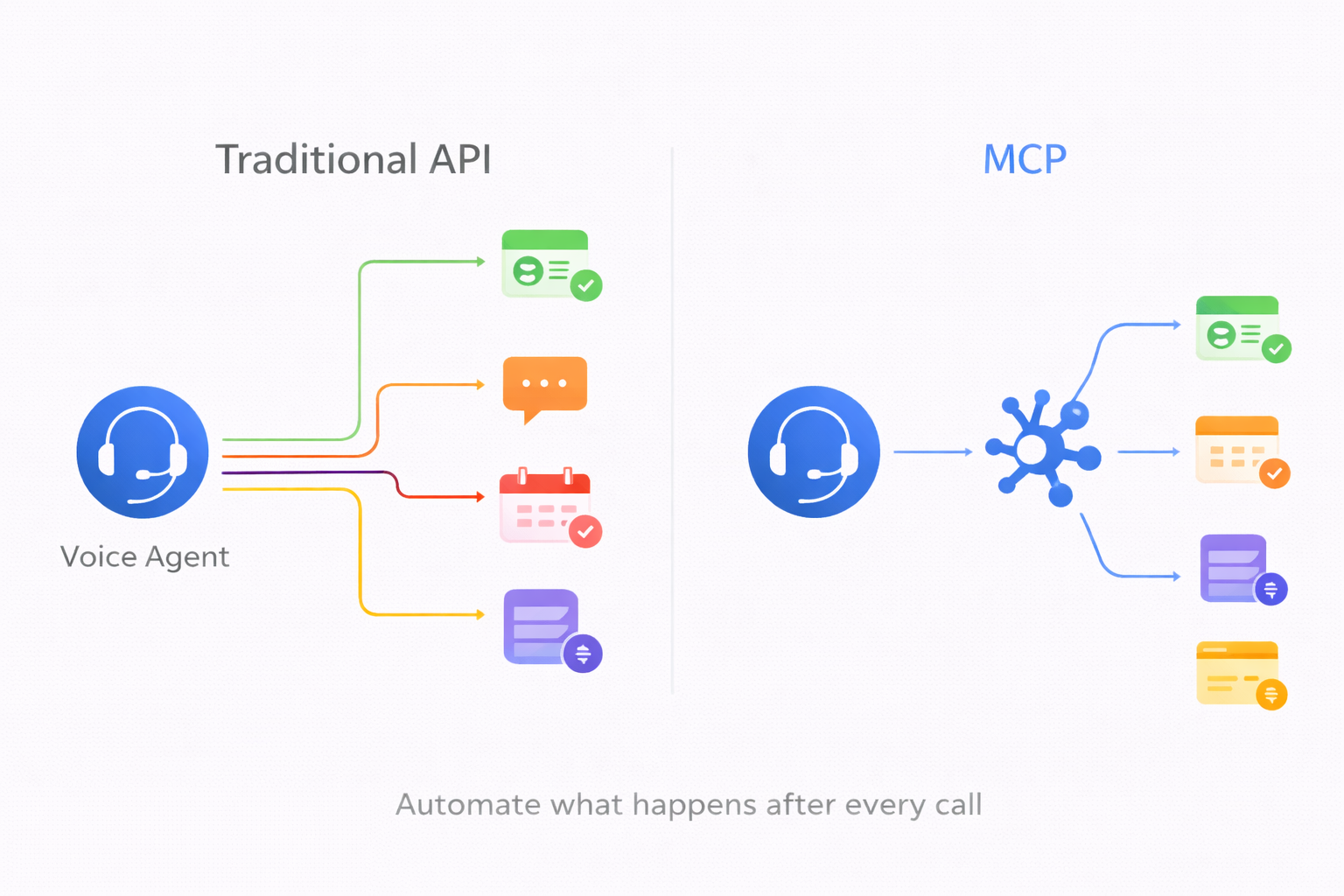
Each API choice affects speed, flexibility, and maintenance.
Building a voice agent means deciding how it connects to every external system it needs during a live call. Traditional APIs require a custom connector for each service. MCP (Model Context Protocol) replaces that with one standard that lets the agent discover and call any tool at runtime.
Here is how the two approaches compare across the features that matter most for voice agents.
MCP vs. Traditional API Integration (Side-by-Side Comparison)
Feature
Traditional API
MCP
Connection model
Point-to-point (one integration per service)
Universal protocol (one standard for all services)
Tool discovery
Hardcoded endpoints defined by developers
Dynamic: agent discovers tools at runtime
Session state
Typically stateless (each request is independent)
Stateful (server maintains context across calls)
Primary consumer
Human developers writing application code
AI agents selecting tools autonomously
Scaling integrations
Linear: one new tool means one new integration
Modular: integrate once, reusable across agents
Latency overhead
Direct HTTP call (low for single requests)
Small server hop (~50ms local, varies remote)
Security model
API keys stored in application code
Credentials isolated on the MCP server side
Best for
Deterministic, single-service calls
Multi-tool voice agents in real time
Key Differences That Actually Impact Performance
The choice between MCP and traditional APIs affects six specific areas of voice agent performance.
Integration scaling: With traditional APIs, every agent-service combination requires its own connector. Five agents and ten services mean fifty integrations. MCP reduces this to fifteen (five clients plus ten servers) because the protocol is standardized, so any MCP-compatible agent can call any MCP server without custom code.
Mid-call tool selection: With APIs, every tool the agent might need must be wired in before deployment. If a caller asks for something you didn't anticipate, the agent can't help. MCP lets the agent discover tools at runtime and pick the right one per request. Add a new MCP server on Monday, and every connected voice agent can use it by Tuesday.
Latency profile: For a single call, direct HTTP is faster. A well-optimized REST endpoint responds in under 20ms, while MCP adds roughly 50ms for local servers. But the comparison shifts as the tool count grows.
Token efficiency: Traditional APIs require the agent's prompt to include every tool schema on every request, which increases token count and LLM processing time. MCP loads only the schemas needed per interaction. For agents with 10+ tools, MCP's selective loading often produces lower net latency.
Credential management: With traditional APIs, keys and tokens live in the agent's environment, and every instance can access all of them. MCP isolates credentials on the server side. The agent requests an action; the server handles auth. For regulated industries, this simplifies compliance. MCP also supports OAuth 2.1 for caller-authorized actions.
Maintenance cost: When a third-party API changes its auth method or response format, every agent using it needs a code update. Ten agents mean ten patches. With MCP, you update one server, and all connected agents inherit the fix. The more agents and services you run, the wider this gap gets.
Each difference grows in impact as your tool count and agent volume increase.
When Should You Use MCP vs. APIs?
Use MCP If:
Your voice agent connects to three or more services during calls.
You need to add new capabilities without redeploying agent code.
You plan to test or switch between LLM providers (OpenAI, Anthropic, Google) and want integrations that work across all of them.
Security requirements demand that API keys and auth tokens stay separated from the agent's execution environment.
Your agent calls one or two services with fixed, predictable behavior.
You need full control over every request and response, with no abstraction layer in between.
The integration is straightforward and unlikely to change (e.g., a single payment endpoint).
Minimizing per-request latency on a single service is the top priority.
The Hidden Cost of API-Based Voice Agents
API-based voice agents are simple to start but expensive to maintain at scale.
Why costs grow over time: Each service connection requires its own auth handling, retry logic, response parsing, and schema maintenance. Five agents connected to ten services means fifty connectors to build and maintain.
Where it breaks: When a provider changes its auth method or deprecates an endpoint, every agent using that connector stops working until a developer patches it. Engineering teams end up spending more time maintaining connectors than building new capabilities.
Why voice agents are more exposed: A failed API call in a batch process is a log entry. A failed call during a live customer conversation is dead air and a lost customer.
How MCP solves this: MCP centralizes integration logic to one server per service. When a backend changes, you update one server and all connected agents inherit the fix automatically.
How MCP Enables True AI-Native Voice Systems
MCP was designed for AI agents, not for developers writing traditional application code. The difference shows up in what a voice agent can actually do during a live conversation.
Dynamic workflow composition: The agent assembles tool calls on the fly based on what the caller needs. A customer calls about an order, then wants to reschedule delivery. The agent discovers and chains the right tools in sequence, no predefined script required. Agentic AI workflows work this way by default.
Reusability across channels: A single MCP server for your CRM works with your voice agent, chatbot, and Slack bot simultaneously. You build the integration once, and every AI-powered channel in your stack can use it. With traditional APIs, each channel typically needs its own connector code.
OAuth 2.1 support: The agent authorizes actions on behalf of callers (booking appointments, pulling account info) without sensitive auth data ever reaching the agent process. The MCP server handles the full OAuth flow.
OpenAI's Realtime API now supports remote MCP servers natively. Voice agents built on that stack can access external tools mid-conversation without custom integration code. In practice, MCP acts as a universal layer between the AI model and your business systems.
Real-World Use Cases
MCP Use Cases
Customer service: A caller asks about the order status. The agent queries the order database via MCP, reads back tracking info, and offers to start a return if the package is delayed. No pre-built integration per query type was needed.
Appointment management: A caller wants to reschedule. The agent checks the calendar through one MCP server and sends a confirmation SMS through another. Both servers were located dynamically during the call, and a new one (say, email confirmation) can be added without changing the agent.
Multi-system lookup: A support call requires CRM history, insurance verification, and a follow-up ticket. Three MCP servers, one conversation. The agent chains the lookups and creates the ticket without custom connector code for any of the three systems.
API Use Cases
Payment processing: The agent confirms a fixed payment amount through Stripe. The flow is deterministic, rarely changes, and the overhead of MCP's discovery layer would add complexity without adding value.
Simple status checks: The agent checks whether a store location is open. One endpoint, one response format, no need for dynamic tool discovery.
Regulated transactions: Compliance requires explicit audit control over every step in the flow. A direct API with structured logging gives you more granular control than routing through an MCP server.
Which One Is Future-Proof?
MCP is becoming the default integration layer for AI agents, with broad industry backing and a growing ecosystem.
Who supports it: OpenAI, Anthropic, and Google DeepMind all support MCP. The Agentic AI Foundation (under the Linux Foundation) governs it as an open standard.
Ecosystem scale: As of early 2026, the official MCP registry lists over 6,400 servers, and SDK downloads have passed 97 million.
Where APIs still fit: APIs are not going away. For AI agents, they are increasingly wrapped inside MCP servers rather than called directly. The API still runs the actual business logic underneath. MCP provides discovery, routing, and security isolation on top.
What most production systems do: Most production voice AI systems in 2026 run both: MCP for multi-tool orchestration, direct APIs for fixed single-service operations.
The question is no longer which one wins. It is knowing when to use each.
How Goodcall Uses MCP to Power Smarter Voice Agents
Goodcall builds AI phone agents that handle real customer calls for businesses ranging from local services to enterprise contact centers.
How it works: Instead of requiring teams to wire up individual API integrations for each service, Goodcall's agentic voice AI manages connections to CRM, scheduling, and follow-up systems through its orchestration layer.
Results in production: Over 42,000 agents on the platform have handled 4.7 million+ calls with real-time response performance.
Post-call automation: Goodcall also connects with Zapier for logging call outcomes, triggering follow-ups, and routing qualified leads to sales, opening up access to apps outside its native integration list.
That means fewer custom builds, faster deployments, and one less bottleneck between your team and a live agent. See how Goodcall works.
For post-call automation like logging call outcomes, triggering follow-ups, or routing qualified leads to sales, Goodcall also connects with Zapier, which opens up access to apps outside its native integration list.
Conclusion: Choosing the Right Integration Strategy
When choosing between MCP and traditional API integration for your voice AI system, go with whatever matches your actual setup.
If your agent talks to one or two services with predictable behavior, direct APIs are simpler and faster. If it needs multiple tools and the ability to scale without code changes, MCP is built for that.
Most production systems use both. Start with whichever fits today and layer in the other as your agent grows.
MCP (Model Context Protocol) is an open standard that lets voice agents discover and use external tools dynamically during live calls. The agent connects to MCP servers that expose tools through a universal protocol, rather than relying on hardcoded integrations written per service.
Is MCP better than traditional APIs?
For voice agents that connect to multiple tools and need to add new ones without redeploying, yes. For simple, single-service calls where you want tight control and minimum latency, direct APIs are still the better fit.
Do I need MCP for simple voice bots?
Probably not. If your bot handles one or two fixed tasks with predictable behavior, direct API calls are simpler and have lower overhead. MCP starts to pay off when your tool count and workflow complexity grow beyond what is practical to hardcode.
Does MCP reduce latency in voice AI?
MCP adds a small server hop (under 50ms locally). But it reduces token overhead by loading only the schemas needed per interaction rather than all of them on every request. For agents with 10+ tools, this selective loading often produces lower net latency.
Can MCP replace APIs completely?
No. MCP wraps APIs into a standardized discovery and routing layer. The underlying API still executes the actual business logic. MCP adds tool discovery, auth isolation, and protocol standardization on top.
What companies use MCP for voice AI?
OpenAI's Realtime API supports MCP natively for mid-call tool access. Anthropic created MCP and donated it to the Linux Foundation's Agentic AI Foundation. Google DeepMind added support in early 2025. Goodcall uses MCP-compatible architecture for voice agent orchestration across CRM, scheduling, and workflow systems.
Explore Goodcall For Free
Try Goodcall's AI Phone Assistants Free for the first 14 days!