#Voice AI
April 6, 2026
MCP (Model Context Protocol) Use Cases: Real-World Applications & Business Impact
Share this post


Explore AI Summary


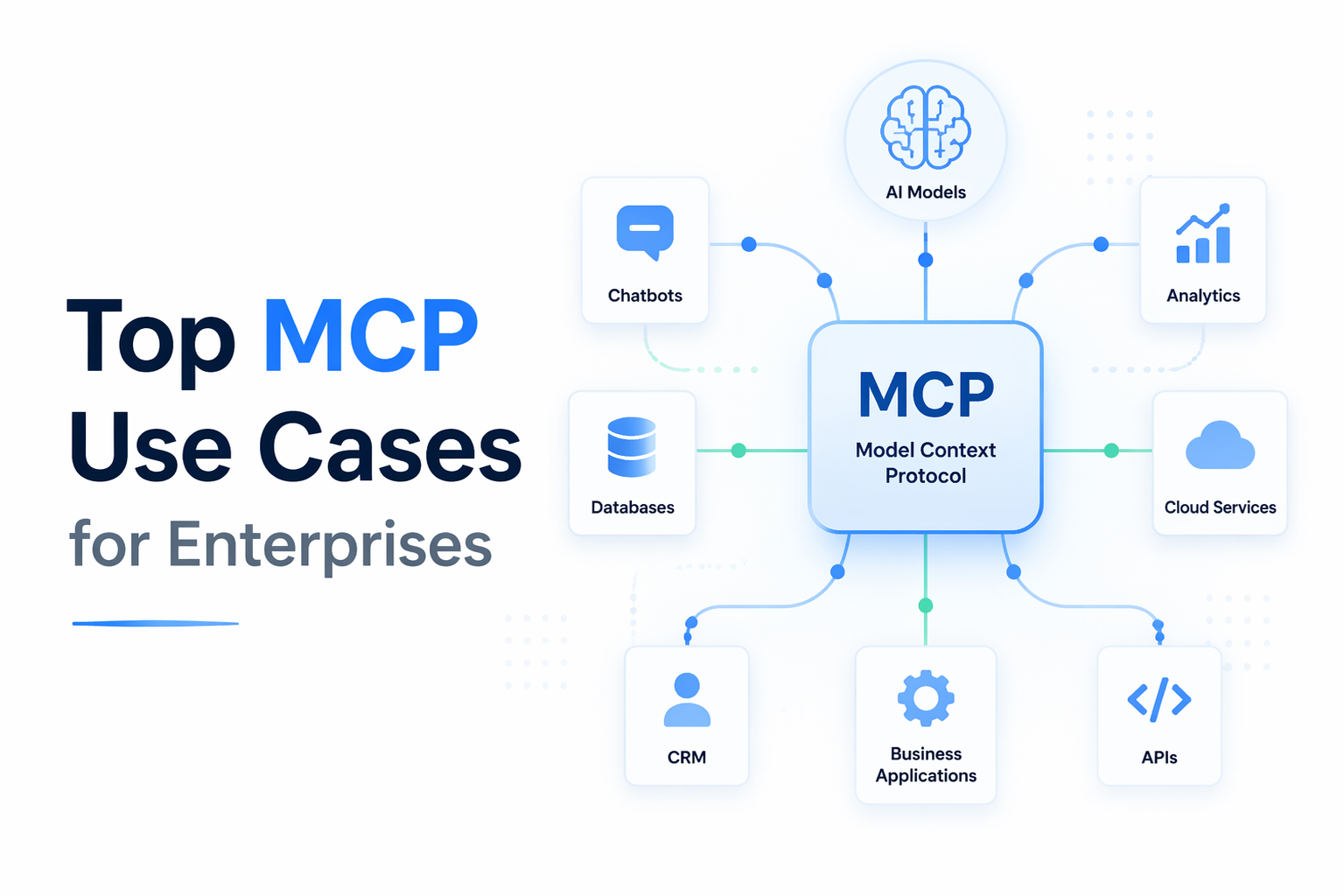
Most AI tools work in isolation. They read what you type, generate a response, and stop there. They cannot check your live database, pull records from your CRM, or act inside your project management system without someone writing custom code for every single connection. That is the gap Model Context Protocol use cases are built to close.
Anthropic released MCP as an open standard for connecting AI models to external tools and data. Since then, companies have deployed it to connect their AI agents to live systems at scale. This article breaks down what is Model Context Protocol, how it works, where it differs from traditional API integration, and which industries are already applying it in production.
Model Context Protocol (MCP) is a framework that helps AI systems connect with external tools, data sources, and applications in a structured way. Instead of working in isolation, it allows AI to access real-time information and perform actions more effectively. Think of it as a bridge between AI models and the systems businesses already use.
In simple terms, MCP gives AI the “context” it needs to understand tasks better and respond more accurately. It standardizes how data is shared, making integrations smoother and more reliable. This helps enterprises build smarter, more useful AI-driven workflows without complex custom setups.
The best way to understand what MCP actually does is to look at where it is already working. The examples below come from companies and platforms that have moved past the pilot stage and are running MCP in production today.
MCP connects your AI coding environment directly to live documentation, so your developers stop copying context manually and start getting accurate suggestions from the first prompt.
Example:
Cursor Pulling Live Docs Directly: Cursor supports MCP natively. Developers connect the Context7 MCP server to pull version-specific library documentation directly into their working session, so the AI generates suggestions from your actual project code and current official docs, not outdated training data.
MCP gives your AI direct access to Salesforce, so your finance and development teams stop waiting on manual data pulls and custom integrations to get answers.
A support AI that cannot read your live Jira and Confluence data is working blind. MCP fixes that by connecting your AI directly to the systems your team already relies on.
Your teams are sitting on valuable data they cannot easily access. MCP connects your AI directly to your databases and data warehouses, no analyst required.
Content workflows slow down when your team is constantly switching between platforms. MCP brings those platforms together inside a single AI session.
MCP gives your DevOps teams direct AI access to their infrastructure tooling, from container management to observability, all through plain-language commands.
Research tasks that once required hours of manual browsing now take minutes. MCP connects your AI to live external data sources, from property listings to any external platform your team regularly pulls information from.
The primary difference between MCP, APIs, and plugins is who they are built for. APIs are built for human developers, MCP is built for AI agents, and plugins are built to extend a specific host application. They each solve a different problem at a different layer.
MCP vs API integration is not a straight comparison because they do not compete. The practical difference comes down to context. APIs are stateless, meaning each request stands alone with no memory of what came before. MCP maintains session state, so your AI can run multiple related actions in sequence without losing the thread.
A plugin bundles tools and instructions for a specific platform, so what you build for one system has to be rebuilt for another. MCP works at a deeper level as the connection layer between AI models and external systems like databases and APIs, usable across any compatible client without modification. Where plugins handle packaging, MCP handles the actual data exchange, which is why the two typically work together.
A standard language model takes input, predicts output, and stops. No memory, no live data, no ability to act. An AI agent reasons, plans, and adjusts mid-task, but it needs a reliable way to call tools, retrieve live information, and carry context across multiple steps to do that effectively. MCP integration is what bridges that gap.
What makes that workflow function comes down to how MCP is structured:
The main benefit of MCP for businesses is that it turns AI from a conversational tool into an operational one, capable of acting directly inside your systems rather than sitting alongside them.
MCP has grown from a concept to an industry standard in roughly sixteen months. Over 5,800 MCP servers and 300 MCP clients are now available, with more than 97 million SDK downloads per month as of early 2026. 72% of current adopters expect to increase their MCP usage in the next twelve months. The infrastructure is already moving faster than most enterprise AI roadmaps.
Security remains the most cited barrier to wider adoption, with prompt injection, over-permissioned tools, and lookalike server attacks identified as real risks in April 2025. Vendors like SGNL and Pomerium have launched MCP gateways in response.
The November 2025 spec introduced Cross App Access, which routes authentication through your enterprise identity provider and gives your IT team full visibility through a single control plane. Google Cloud's Apigee is actively working to make MCP reliable for production-grade deployments.
Moving MCP from experimental setups into stable production applications is the work still ahead. Your team should treat security configuration as a deployment requirement from day one, not something addressed after the fact.
AI is only as useful as the data it can access and the actions it can take. MCP gives your AI agents a standard, secure way to connect to the tools and data they need, removing the custom integration burden while giving your team real control over what the AI can and cannot do.
That's the foundation modern AI customer service automation is being built on, and Goodcall is built around exactly that. If your business handles inbound calls and wants AI agents that connect directly to your systems and resolve requests without human involvement, the infrastructure is ready. The only question is how quickly you put it to work.
Ready to transform how your business handles calls? Goodcall delivers intelligent voice agents that close more deals and reduce costs. Experience results firsthand with a free 14-day demo.
What is MCP in AI?
MCP stands for Model Context Protocol. Anthropic introduced it as an open standard in November 2024, allowing your AI systems to connect with external tools, databases, and workflows. Rather than relying on training data alone, your AI can pull live information and take real actions through connected systems during an active session.
How is MCP different from APIs?
APIs are built for developers writing code against specific endpoints. MCP is built for AI agents that need to discover tools at runtime, maintain session state across multiple steps, and reach different services through one standard interface. It sits on top of existing APIs and removes the need for custom integration code every time you add a new connection.
Is MCP secure for enterprise use?
MCP enforces authentication and authorization at the connection layer. You control which models access which tools and restrict sensitive actions through permission-based settings. Security researchers identified risks in April 2025, including prompt injection and over-permissioned tools, so server vetting should be a standard part of your deployment process.
Who created MCP?
Anthropic created and open-sourced MCP in November 2024. In December 2025, it donated the protocol to the Agentic AI Foundation, a directed fund under the Linux Foundation, co-founded with Block and OpenAI. No single company controls its direction today.
What industries benefit most from MCP?
Software development, financial services, healthcare, customer support, and enterprise data operations are getting the best results from MCP. If your work involves AI agents that need access to live, structured data from multiple systems, MCP delivers direct and measurable benefits to your existing workflows.
Is MCP open source?
Yes, MCP is fully open source. The specification, SDKs, and reference server implementations are publicly available on GitHub. Model Context Protocol use cases continue to expand as the ecosystem grows, supported by official SDKs in Python, TypeScript, C#, Go, Kotlin, Java, and Ruby.