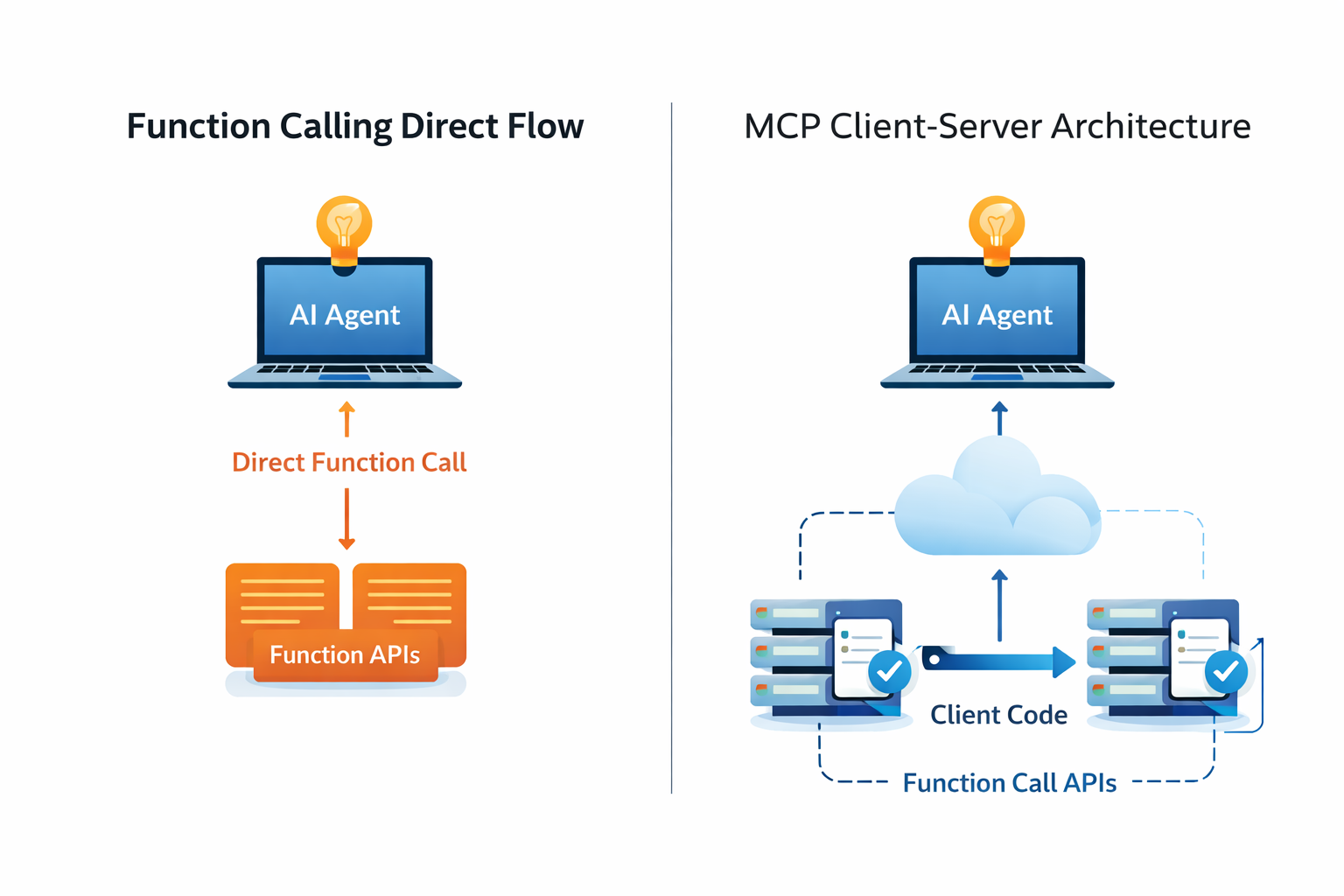
When comparing MCP vs. function calling, the core difference is scope. Function calling is a built-in LLM feature that lets a model request a specific tool. MCP (Model Context Protocol) is an open standard that gives AI agents a universal way to discover and use tools across any provider.
Function calling handles the individual tool request. MCP manages how tools are found, connected, and run at scale. This guide covers the key differences so you can pick the best AI phone agent framework for your business.
Quick Answer: MCP vs. Function Calling
Function calling lets a large language model request a specific tool by generating structured JSON with the function name and arguments. MCP standardizes how AI agents find, connect to, and use many tools through persistent servers that work across providers like OpenAI, Anthropic, and Google.
Function Calling is Best for: Rapid prototyping, simple bots with one to three actions (check a stock price, retrieve an order status, toggle a smart device), and single-provider deployments where setup speed matters most.
MCP is Best for: Production AI call automation systems with multiple backend integrations, cross-provider flexibility, and enterprise deployments where security, governance, and tool scalability are priorities.
Feature
Function Calling
MCP
Type
LLM capability (per-request)
Open protocol (persistent servers)
Provider Support
Vendor-specific (OpenAI, Anthropic, Google each differ)
Universal across all major providers
Tool Discovery
Static: tools defined in every API call
Dynamic: agents discover tools at runtime
Scalability
Degrades as tool count grows (token overhead)
Modular: add tools without changing agent code
Setup Complexity
Low: a few lines of code
Moderate: requires MCP server configuration
Latency
Slightly lower for single-step tasks
Small overhead from server communication
Security
API keys live inside the agent runtime
Credentials stay isolated on MCP servers
Best Use Case
Quick scripts, small bots
Enterprise agents, multi-tool systems
Adoption (2026)
Mature, widely documented
97M+ monthly SDK downloads
Governance
Managed by individual providers
Linux Foundation (Agentic AI Foundation)
What Is Function Calling in AI Agents?
Function calling is a feature built into large language models that lets them request external tools by outputting structured data.
Mechanism: The model generates a JSON object with the function name and arguments. Your application executes the function and returns the result. The model does not run the tool itself.
How it works: You send the user's message alongside tool schemas. The model decides if a tool is needed, generates the call, and your app runs it.
Provider support: OpenAI introduced function calling in 2023. Anthropic offers tool use for Claude. Google provides function declarations for Gemini. The concept is the same, but formats differ between providers.
Limitations: Schemas are vendor-specific, so switching providers means rewriting them. Every definition is sent in every API call, creating a "context tax" that grows with tool count. At 50 tools, you spend 10,000 to 20,000 tokens on descriptions before the model reads the user's message.
What Is Model Context Protocol (MCP)?
MCP is an open standard introduced by Anthropic in November 2024 that standardizes how AI agents connect to external tools and data sources.
Mechanism: MCP uses a client-server architecture. Your AI app (the MCP Host) connects to standalone MCP Servers that expose tools, data, and prompt templates. Communication runs over JSON-RPC 2.0 using stdio (local) or HTTP with Server-Sent Events (remote).
How it works: The agent connects to a server and asks what tools are available. The server returns a capability list. Adding a new tool means deploying a new server. The agent discovers it automatically. No code changes needed.
Why it exists: Before MCP, connecting an AI model to a tool required a custom integration for each combination. Anthropic called this the "N×M" problem. Ten models and 100 tools could mean 1,000 unique connectors. MCP reduces that to one standard.
Adoption: 97 million monthly SDK downloads by late 2025. Over 10,000 public servers and 300+ clients. In December 2025, Anthropic donated MCP to the Agentic AI Foundation under the Linux Foundation, co-founded with Block and OpenAI. Frameworks like LangChain, LlamaIndex, and Microsoft AutoGen use MCP as their default tool layer.
MCP vs. Function Calling: Key Differences, Features, and Use Cases
Architecture. Function calling runs inside the model's request-response cycle. MCP creates a separate layer where tools run on independent servers. For agentic AI systems managing CRMs and payment platforms, MCP prevents breakage when APIs change.
Scalability. Function calling sends every schema in every request. The overhead scales linearly with tool count. MCP loads only what is needed per interaction. You can scale into hundreds of tools without increasing prompt size.
Provider portability. OpenAI, Anthropic, and Google each use different formats. Switching providers with function calling means rewriting every schema. MCP is provider-agnostic. Build one server, use it with any client.
Security. Function calling stores API keys inside the agent runtime. MCP isolates them on the server side. For enterprise voice AI deployments, this reduces compliance risk.
Latency. Function calling is faster for single-step tasks (no server hop). MCP adds under 50 milliseconds for local servers. For real-time voice applications, benchmark remote servers against your response time targets.
Function Calling vs. MCP: Which Is Better for AI Phone Agents?
MCP is the stronger choice for production AI phone agents. Voice agents operate under tight timing constraints. A response must start within 500 milliseconds to sound natural.
During a single call, the agent may need to:
Verify caller identity against a database
Check appointment availability in a scheduling platform
Pull CRM history for personalized responses
Send a confirmation via SMS or email
Each of those is a separate tool interaction. With function calling, every schema rides along in every API call, even tools the agent does not use. As the tool count grows, costs increase. With MCP, each backend runs as its own server. Adding a new capability means deploying one server, not rewriting the agent.
This is already happening in production. OpenAI's Cookbook includes an MCP-powered voice framework for phone automation. Retell AI offers native MCP support for mid-call tool execution. Bandwidth documented MCP as a universal adapter for voice AI integration.
For teams that need production-ready AI phone agents without managing infrastructure, Goodcall handles orchestration end-to-end. You deploy agents that connect to CRM, scheduling, and workflows out of the box. Over 42,000 agents have handled 4.7 million+ calls with real-time response performance.
Common Mistakes When Choosing Between MCP and Function Calling
Using MCP for a simple bot: If your agent answers three FAQs and transfers to a human, MCP adds unnecessary complexity. Function calling is the right fit for small, stable, single-provider setups.
Sticking with function calling for too long: Teams often start with function calling (the right early choice), then resist migrating as the tool count grows past 15 or 20. By that point, costs have quietly increased, and every new tool requires codebase changes.
Treating them as either/or: MCP uses function calling internally. The model still generates structured tool requests. MCP standardizes how those requests are routed. Many production systems use both: function calling for lightweight tasks, and MCP for everything else.
Ignoring credential exposure: Hardcoding API keys in the agent runtime is acceptable during development. In production, especially in healthcare, finance, or any regulated industry using AI voice systems, it creates compliance risk. MCP's server-side isolation addresses this directly.
Skipping latency tests for voice use cases: For text chatbots, 30 to 50ms of MCP overhead is invisible. For AI voice agents on live calls, the difference between local and remote MCP servers can affect whether callers perceive the agent as natural or robotic. Always benchmark your specific setup.
Conclusion
Function calling gave AI agents the ability to use external tools. MCP gave them a universal standard for doing it across providers and at scale. When choosing between MCP vs. function calling, match the approach to your complexity. For simple bots, function calling remains the fastest path. For production AI phone agents handling live calls with multiple backend connections, MCP is the architecture that grows without breaking.
If your goal is to automate customer calls with orchestration, CRM integration, and sub-second response timing already handled, Goodcall is built for that.
FAQs
What is the difference between MCP and function calling?
Function calling is a built-in LLM capability that outputs structured JSON to request a tool. MCP is an open protocol that standardizes how AI agents discover, connect to, and manage tools across providers. Function calling is the mechanism. MCP is the infrastructure layer.
Is MCP better than function calling?
For multi-tool systems needing provider portability and server-side security, yes. For simple agents with a few tools on a single provider, function calling is more practical.
Which is faster: MCP or function calling?
Function calling is slightly faster for single-step calls (no server hop). For multi-tool workflows, MCP can be more efficient because it avoids sending every schema in every request.
Can you use both MCP and function calling together?
Yes. MCP uses function calling internally. The model still generates structured requests. MCP standardizes routing and execution. Many production deployments use both.
What is best for AI phone agents?
MCP. Production voice agents require multiple simultaneous integrations and need to add capabilities without code changes. MCP's dynamic tool discovery and provider-agnostic design prevent bottlenecks as the system scales.
Does MCP increase cost?
No. MCP typically reduces spend. It loads only the tools needed per interaction. Function calling sends all schemas as tokens in every API call, and that overhead grows with every tool you add.
Explore Goodcall For Free
Try Goodcall's AI Phone Assistants Free for the first 14 days!