Vapi AI Review: Features, Pricing, Use Cases & Best Alternatives
March 27, 2026

Vapi AI Review: Is It the Right Voice AI for Your Business?

Share this post
Explore AI Summary

Ever felt like every AI tool promises the moon but barely lands on your desk? Finding the ones that actually work can feel like a game of trial and error. Vapi AI is one of the tools getting attention, and it raises the question: how does it actually perform in real-world use?

This article provides a detailed Vapi AI review, analyzing its features, pricing, use cases, and limitations. It also compares alternatives and evaluates whether it fits enterprise needs, giving you a clear perspective before making a decision.

Vapi AI Overview

The Vapi voice AI platform provides infrastructure for building real-time AI-powered voice agents. It connects speech recognition, language models, and telephony into a single programmable system. This enables businesses to automate phone conversations with high flexibility.

Unlike traditional IVR systems, Vapi focuses on dynamic, context-aware conversations. It allows developers to design custom workflows for AI phone agents for call centers and enterprise operations. This makes it suitable for teams that need control over voice AI behavior and integrations.

Key Capabilities of Vapi AI:

  • Real-time voice streaming: Enables low-latency conversations with near-human response times.
  • LLM integration: Connects with models like OpenAI for dynamic and context-aware responses.
  • Speech-to-text and text-to-speech: Converts spoken language into structured data and vice versa.
  • Call handling infrastructure: Supports inbound and outbound calls through telephony integrations.
  • Custom workflows and APIs: Developers can build logic-based flows for different business scenarios.
  • Scalability for enterprise workloads: Designed to handle high call volumes without performance degradation.

These features make it suitable for businesses building advanced AI phone agents for call centers.

Typical Industries Using Vapi

  • Healthcare: Automates appointment scheduling, patient follow-ups, and reminders, improving operational efficiency and reducing administrative workload.
  • E-commerce and retail: Handles order tracking, returns, and customer queries, enhancing support experiences and reducing response times.
  • Financial services: Manages account inquiries, payment reminders, and fraud alerts while maintaining secure and compliant communication processes.
  • Logistics and transportation: Provides delivery updates and dispatch coordination, improving real-time communication and operational visibility.
  • Customer support operations: Deploys AI phone agents for call centers to manage high call volumes with consistent and scalable service quality.

How Vapi AI Works

Vapi operates as a programmable layer that connects multiple AI and telephony components into a unified system.

At its core, the workflow follows a structured pipeline:

  1. Call initiation: A call is triggered through integrated telephony systems for inbound or outbound communication.
  2. Speech-to-text processing: The system converts spoken input into text using real-time speech recognition models.
  3. Intent recognition with LLMs: Language models analyze input to understand context, intent, and conversation flow.
  4. Response generation: The AI constructs relevant, context-aware replies based on predefined logic and dynamic inputs.
  5. Text-to-speech conversion: Generated responses are converted into natural-sounding voice output.
  6. Real-time streaming delivery: The system delivers responses instantly to maintain smooth and human-like conversations.

This architecture allows Vapi to function as one of the best AI voice agent platforms for developers seeking flexibility. However, it requires technical setup and integration, which may impact adoption for non-technical teams.

Vapi AI Enterprise Use Cases

Enterprises are increasingly adopting voice AI to automate repetitive interactions and reduce operational costs. Vapi supports a range of enterprise-grade applications:

  • Customer Support Automation: AI agents handle common queries such as order status, refunds, and FAQs. This reduces call center workload and improves response time.
  • Outbound Sales and Lead Qualification: Businesses use AI agents to conduct cold calls, and qualify leads. This improves efficiency in sales pipelines.
  • Appointment Scheduling: Healthcare and service providers automate booking, reminders, and cancellations. This reduces no-shows and manual coordination.
  • Collections and Payment Reminders: Financial institutions use AI agents to follow up on payments. These agents ensure consistent and timely communication.
  • Internal Operations: Companies automate internal calls for HR queries, IT support, and employee assistance.

These use cases highlight why Vapi is considered among emerging enterprise voice AI platforms.

Vapi AI Pricing Breakdown

Understanding Vapi AI pricing requires looking beyond the base rate. The Vapi voice AI platform offers a flexible pricing approach with both usage-based and enterprise options.

Pricing Models Overview

  • Usage-based model: Suitable for smaller deployments with per-minute billing.
  • Enterprise plan: Custom pricing designed for high-volume, large-scale operations.
  • Free trial: Limited credits available for testing and evaluation.

Vapi AI Pricing Plans

Plan Type Base Pricing Typical Total Cost Key Limitations
Pay-as-you-go ~$0.05 per minute ~$0.30–$0.33 per minute Limited concurrent calls (approx. 10)
Enterprise Custom pricing ~$40,000–$70,000 per year Requires technical implementation
Free Trial ~$10 credits ~150–200 minutes usage Limited testing capabilities

What Drives the Actual Cost

Although the base rate starts low, the real cost comes from combining multiple services. Most Vapi AI reviews emphasize that businesses must account for the full AI stack.

Key contributors include:

  • Platform hosting fees: The platform charges around $0.05 per minute for handling and orchestrating active voice calls.
  • Speech-to-text (STT): Transcription typically costs about $0.01 per minute, depending on the provider used.
  • LLM processing: Language model usage ranges from $0.02 to $0.20 per minute based on model complexity and response length.
  • Text-to-speech (TTS): Voice generation adds approximately $0.04 per minute, depending on voice quality and provider.
  • Telephony services: Call connectivity costs around $0.01 per minute through providers like Twilio or similar platforms.

When combined, the actual cost of running AI voice agents typically falls between $0.13 and $0.31+ per minute, depending on configuration.

Pros and Cons of Vapi AI

Vapi delivers a flexible and developer-centric voice AI infrastructure for building real-time conversational systems. However, like most enterprise voice AI platforms, it involves trade-offs that businesses must evaluate carefully:

Pros

  • Natural Conversation Handling: Enables fluid, human-like interactions using real-time processing and advanced language models.
  • Model-agnostic architecture: Supports multiple LLM, STT, and TTS providers, giving businesses flexibility in technology choices.
  • Scalable infrastructure: Handles high call volumes efficiently, making it suitable for growing enterprise deployments.
  • High flexibility for developers: Offers APIs and programmable workflows for building tailored AI phone agents for call centers.
  • Extensive customization: Allows businesses to design unique conversational flows and integrate with internal systems.
  • Low latency: Ensures fast response time, which is critical for maintaining natural voice conversations.

These advantages position Vapi among the best AI voice agent platforms for technical teams.

Cons

  • Complex pricing structure: Multi-layered costs across services make Vapi AI pricing difficult to predict at scale.
  • Requires technical expertise: Setup and maintenance demand experienced developers and engineering resources.
  • Voice-only focus: Lacks native support for omnichannel interactions like chat or email.
  • Limited built-in integrations: Requires additional effort to connect with CRMs and enterprise tools.
  • Limited out-of-the-box features: Compared to other enterprise voice AI platforms, it offers fewer ready-made solutions.

These limitations often play a significant role in prompting businesses to explore Vapi AI alternatives.

Vapi AI Alternatives

While Vapi offers flexibility, several alternatives provide more managed or enterprise-focused solutions.
1. Retell AI

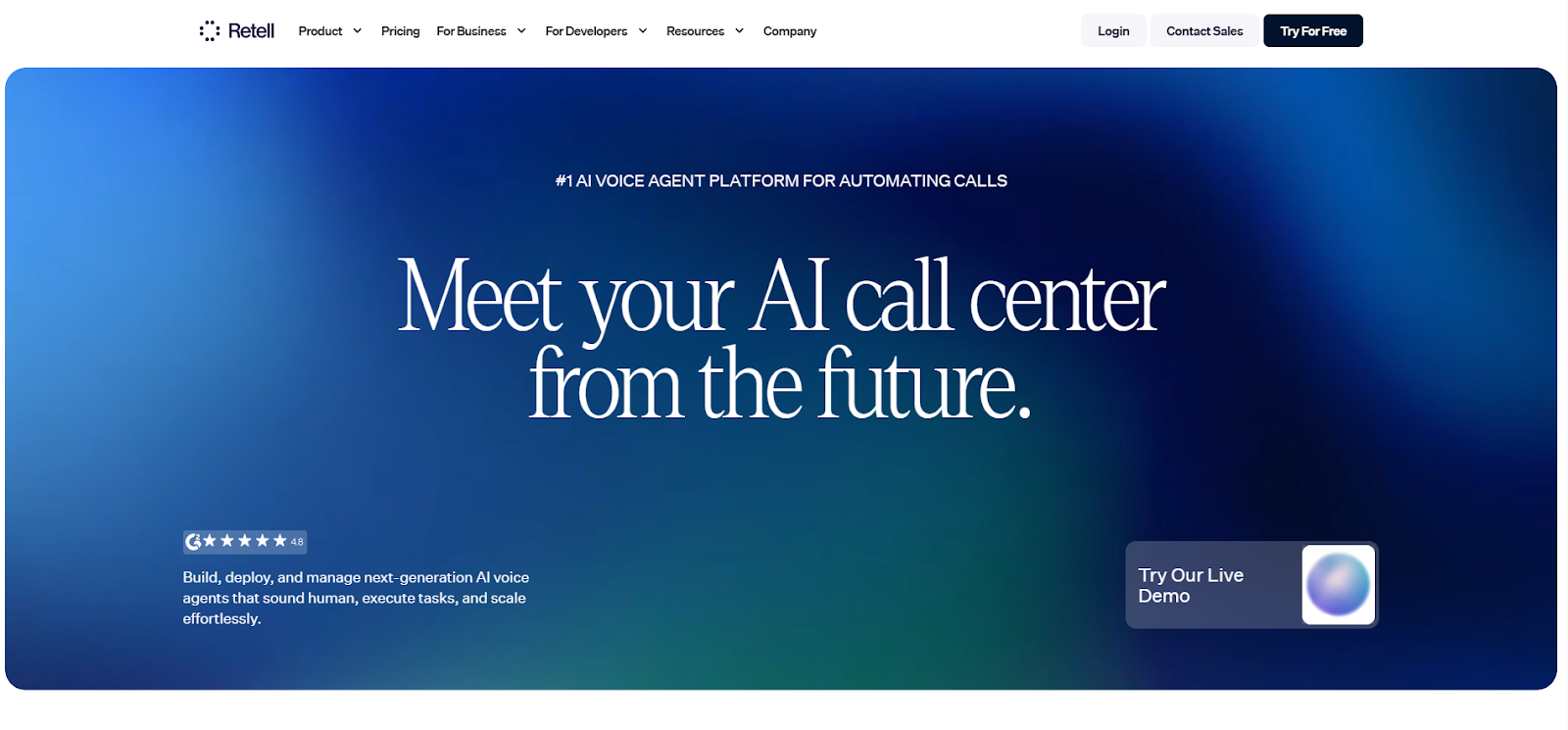
Retell AI is a voice AI platform focused on building production-ready AI phone agents with minimal setup. It simplifies deployment compared to developer-heavy platforms and is designed specifically for call center automation and outbound workflows.

Key features

  • Prebuilt voice agent workflows
  • Real-time conversational AI with low latency
  • Built-in telephony and call handling
  • CRM and business tool integrations

Best for: Companies seeking fast deployment of AI phone agents for call centers without heavy engineering effort.
2. Cartesia

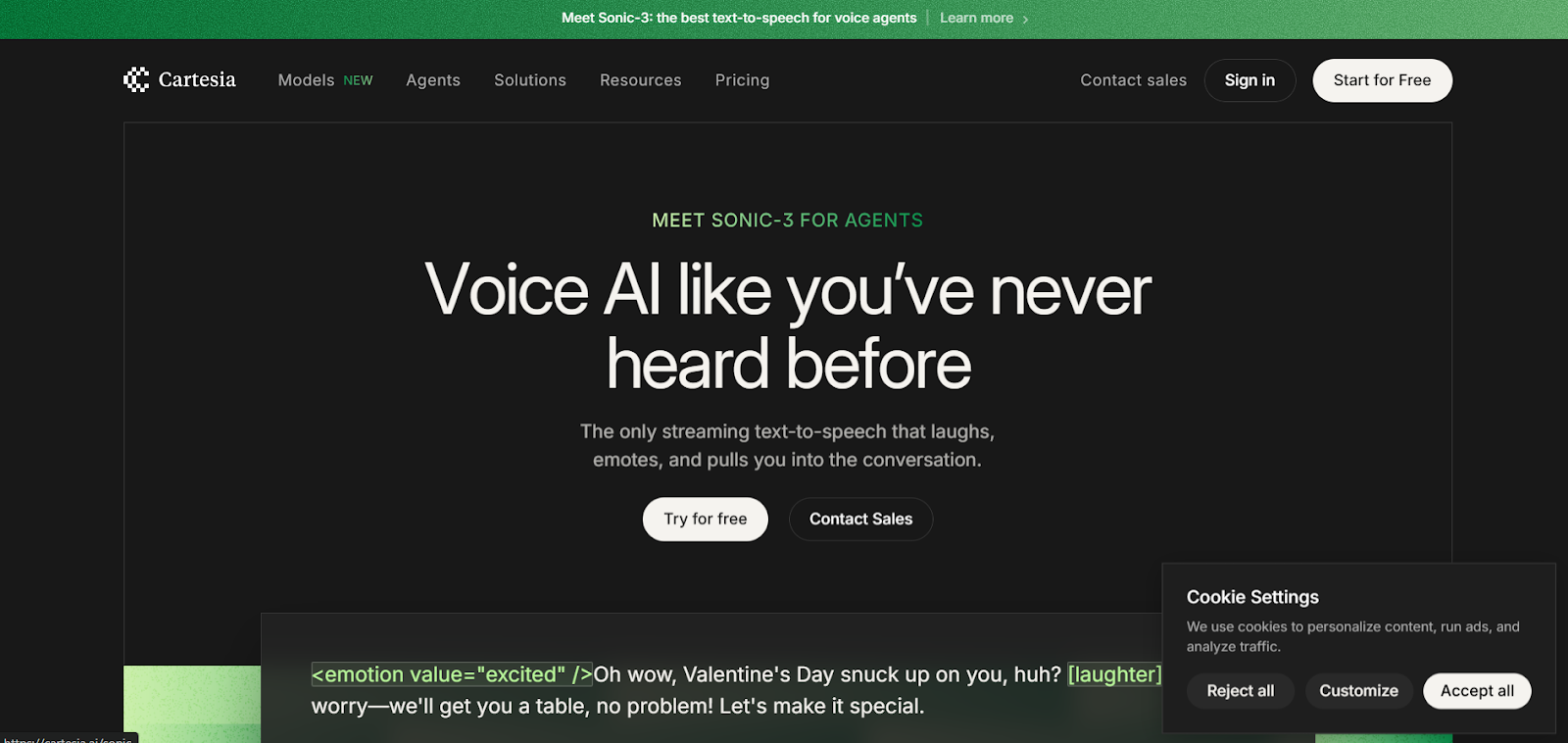
Cartesia is a high-performance voice AI platform specializing in ultra-realistic speech generation and low-latency voice synthesis. It focuses primarily on voice output quality and serves as a core component for building advanced voice applications rather than a complete agent platform.

Key features

  • Ultra-low latency voice generation with near real-time response speeds
  • Advanced voice cloning and expressive speech capabilities
  • Multilingual support across 15+ languages
  • Developer-friendly APIs with flexible deployment options

Best for: Developers building custom voice systems who need high-quality speech generation within enterprise voice AI platforms.

3. Google Dialogflow CX

Google Dialogflow CX is an enterprise-grade conversational AI platform designed to build advanced voice and chat agents. It offers a visual interface and deep integration with Google Cloud, making it suitable for complex, large-scale deployments.

Key features

  • Supports both voice and chat-based virtual agents
  • Visual flow builder for designing complex conversations
  • Natural language understanding (NLU) for intent detection
  • Omnichannel support including phone, web, and apps

Best for: Enterprises needing scalable, multi-channel conversational AI within established cloud ecosystems.
4. Bland AI

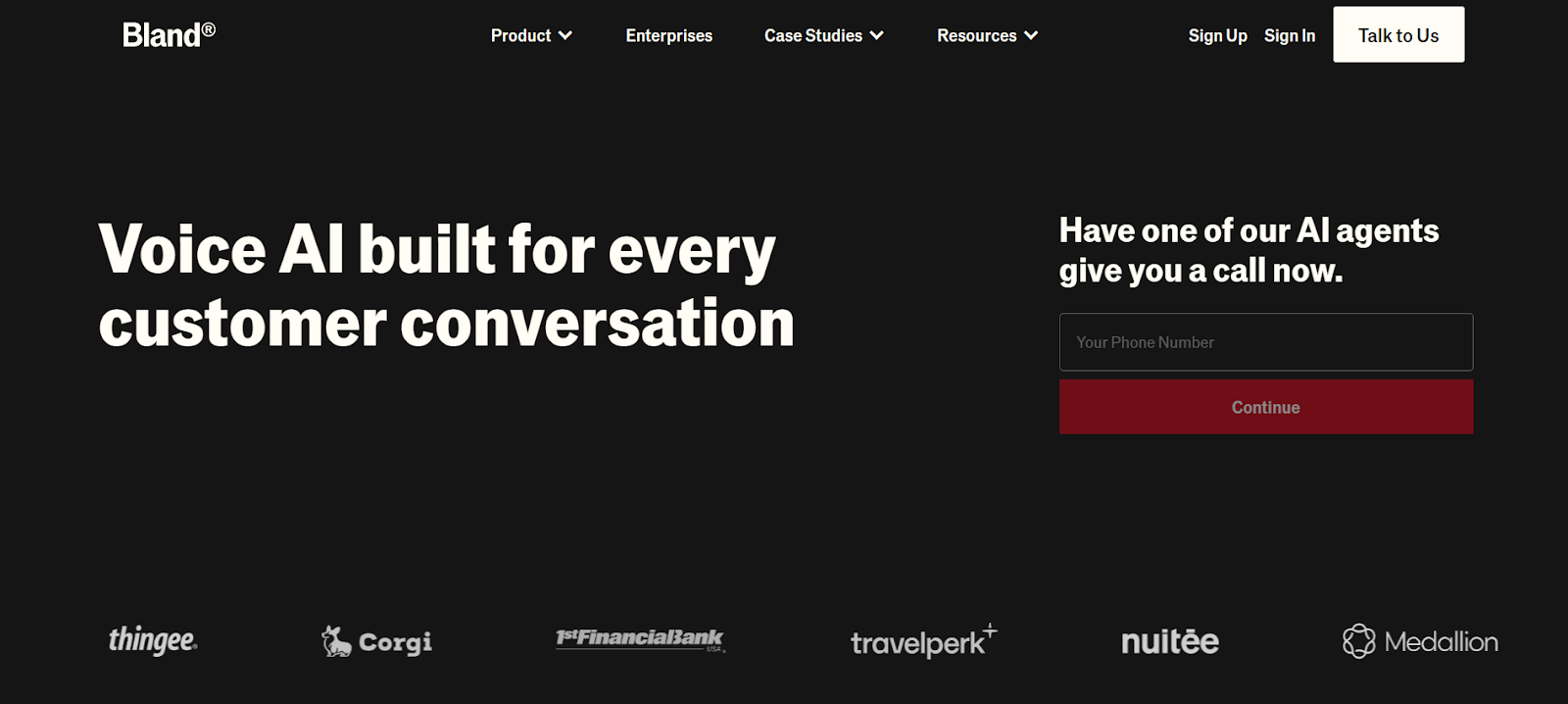
Bland AI is a voice AI platform focused on automating outbound phone calls with high efficiency. It is designed for businesses that prioritize speed and scalability in voice outreach rather than deep customization.

Key features

  • Automated outbound calling at scale
  • Simple API-based setup for quick deployment
  • Focused voice automation for sales and follow-ups
  • Cost-efficient for high-volume call operations

Best for: Businesses prioritizing outbound automation and looking for simple AI phone agents for call centers without complex infrastructure. 
5. Synthflow AI

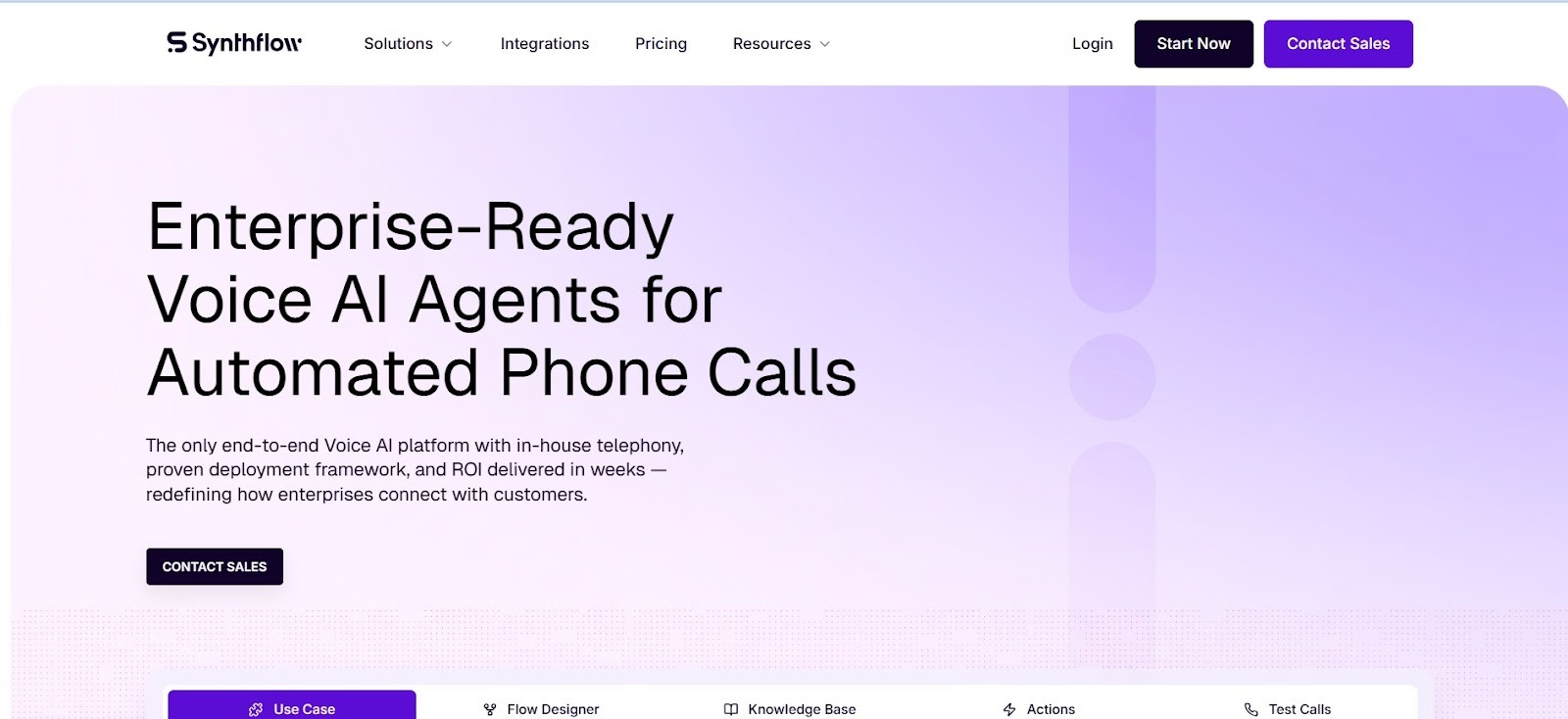
Synthflow AI is a no-code voice AI platform that enables businesses to build and deploy AI phone agents quickly. It offers an end-to-end system, combining telephony, AI models, and workflows without requiring multiple integrations.

Key features

  • No-code drag-and-drop builder for creating voice agents without engineering support
  • Built-in telephony infrastructure for faster, low-latency conversations
  • Real-time, human-like voice interactions with multilingual support
  • CRM integrations and automation for support, sales, and scheduling workflows
  • Handles both inbound and outbound calls with scalable performance

Best for: Businesses looking for a no-code alternative to developer-heavy enterprise voice AI platforms with faster deployment and built-in infrastructure.

Goodcall Voice AI Solutions for Enterprise

Goodcall is an enterprise-grade voice AI platform designed to automate inbound and outbound calls using conversational AI and workflow automation. It combines natural language understanding, call handling, and business integrations to streamline operations across sales, support, and internal workflows.

Why Enterprises Choose Goodcall

  • End-to-end voice AI platform: Provides a complete system for call automation without requiring multiple third-party integrations.
  • Prebuilt enterprise workflows: Faster deployment compared to developer-heavy platforms.
  • Advanced conversational intelligence: Optimized for real-world business interactions.
  • 24/7 call handling: AI agents provide round-the-clock availability, ensuring no missed calls or lost business opportunities.
  • Scalable enterprise performance: Handles high call volumes without performance drops, supporting growth and peak demand scenarios.
  • Context-aware conversations: Uses AI to understand intent and deliver natural, goal-driven interactions instead of scripted responses.
  • Reduced operational costs: Automates repetitive tasks, helping enterprises lower call center expenses while improving efficiency.

Goodcall is designed for businesses that want results without heavy engineering effort. It stands out among modern enterprise voice AI platforms.

Final Verdict: Is Vapi AI the Right Fit?

This Vapi AI review shows that Vapi AI is built for flexibility, scalability, and real-time voice innovation. It works best for teams with strong technical capabilities that want full control over their voice AI stack.

However, enterprises seeking faster deployment and simpler operations may benefit from more managed enterprise voice AI platforms. The right choice depends on balancing customization, cost, and ease of implementation.

Looking for a simpler voice AI for your business? Choose Goodcall to automate every call effortlessly without complex setup.

FAQs

What is Vapi AI used for?

Vapi AI is used to build and deploy AI-powered voice agents that handle real-time phone conversations. Businesses use it for customer support, outbound calling, appointment scheduling, and automating repetitive interactions across call center and operational workflows.

Is Vapi AI good for enterprises?

Vapi can work for enterprises with strong technical teams. It offers flexibility and scalability but requires development effort, integration management, and cost monitoring compared to fully managed solutions.

How much does Vapi AI cost?

Vapi AI pricing is usage-based, starting around $0.05 per minute for platform usage. Total costs typically range from $0.30 per minute or higher, depending on speech processing, language models, and telephony services used.

Is Vapi AI no-code?

No, Vapi AI is not a no-code platform. It requires development expertise to integrate APIs, configure workflows, and manage infrastructure, making it more suitable for engineering teams rather than non-technical business users.

What are the best Vapi AI alternatives?

Popular Vapi AI alternatives include Twilio, Dialogflow, Amazon Connect, Retell AI, and Goodcall. These platforms offer different levels of customization, ease of use, and enterprise readiness.

Can Vapi AI handle outbound calls?

Yes, Vapi AI supports outbound calling. Businesses use it for sales outreach, lead qualification, payment reminders, and follow-ups, enabling automated and scalable communication through AI-powered voice agents.