

Leading Platforms for Voice AI in Call Deflection To Maximize ROI and Efficiency
.jpg)
What if your busiest call center day felt like your quietest? Imagine thousands of customer queries resolved instantly with no hold music, no transfers, no frustration, just natural, human-like conversations. As customer expectations skyrocket and operational costs climb, businesses are rethinking the front line of support. This is where leading platforms for voice AI in call deflection are making an impact, turning high call volumes into streamlined, automated resolutions that feel effortless.
In this blog, we’ll dive into the leading voice AI platforms for call deflection, exploring the technologies redefining customer engagement, and key features that set them apart, helping you choose the right platform for your organization.
What Is Voice AI for Call Deflection?
Voice AI for call deflection uses conversational AI automation to handle inbound calls without human intervention. It understands natural speech, identifies caller intent, and resolves routine queries through automated conversations. This helps businesses reduce inbound call volume while maintaining consistent support quality.
Unlike traditional IVR, modern conversational AI for call centers enables dynamic, human-like interactions. It can route calls, answer FAQs, process requests, and escalate complex issues when needed. This makes AI call deflection software a core component of scalable call center automation platforms.
Key functions of voice AI for call deflection include:
- Answering repetitive inquiries
- Appointment scheduling
- Payment processing
- Order tracking
- Routing complex calls
Features to Look for in Leading Voice AI Platforms
Selecting the right platform requires evaluating both technical intelligence and operational scalability. Here are the key features to look for in leading Voice AI platforms for call deflection:
- Natural Language Understanding (NLU): Advanced NLU enables conversational AI in call centers to understand intent, context, and sentiment, delivering accurate, human-like responses.
- Automated Call Routing System: An intelligent automated call routing system directs callers based on intent, priority, and agent skills to improve resolution speed.
- Omnichannel Deflection Capabilities: Top AI call deflection software seamlessly redirects callers to SMS, chat, or portals to reduce inbound call volume efficiently.
- CRM and System Integrations: Strong integrations connect voice AI with CRMs and helpdesks, enabling personalized interactions and streamlined workflows across call center automation platforms.
- AI Voice Bot Customization: A configurable AI voice bot for customer support supports tailored scripts, workflows, and multilingual conversations for diverse customer needs.
- Analytics and Reporting Dashboard: Comprehensive analytics track deflection rate, containment, and performance metrics to optimize the intelligent virtual assistant for phone calls continuously.
- Enterprise-Grade Security and Compliance: An enterprise voice AI platform must provide encryption, access controls, and regulatory compliance to protect sensitive customer data.
Comparison Table – Top Voice AI Platforms for Call Deflection
| Platform | Core Strengths | Deflection Channels | Best For |
|---|---|---|---|
| Poly AI | Advanced conversational voice agents with human-like dialogue, strong NLU, and enterprise-grade automation for complex customer interactions | Voice (Conversational IVR, inbound automation) | Large enterprises handling high call volumes and complex service workflows |
| Goodcall | AI-driven call automation with fast deployment, CRM integrations, and smart routing designed to reduce inbound call volume efficiently | Voice, SMS-based redirection | SMBs and service businesses seeking scalable AI call deflection software |
| Google Contact Center AI | Enterprise voice AI platform powered by advanced speech recognition, intent detection, and deep cloud scalability | Voice, Chat, Omnichannel | Global enterprises requiring robust conversational AI for call centers |
| Bland AI | API-first voice automation platform enabling rapid deployment of programmable AI voice agents | Voice (API-driven automation) | Tech-driven startups and businesses needing customizable voice workflows |
| Synthflow AI | No-code voice AI builder for creating automated call flows without complex development requirements | Voice | SMBs and agencies seeking easy-to-deploy voice AI solutions |
| Five9 | Cloud-based call center automation platform combining intelligent virtual assistants with workforce optimization tools | Voice, Digital Channels | Mid-size to enterprise contact centers focused on CX optimization |
Leading Platforms for Voice AI in Call Deflection
1. PolyAI
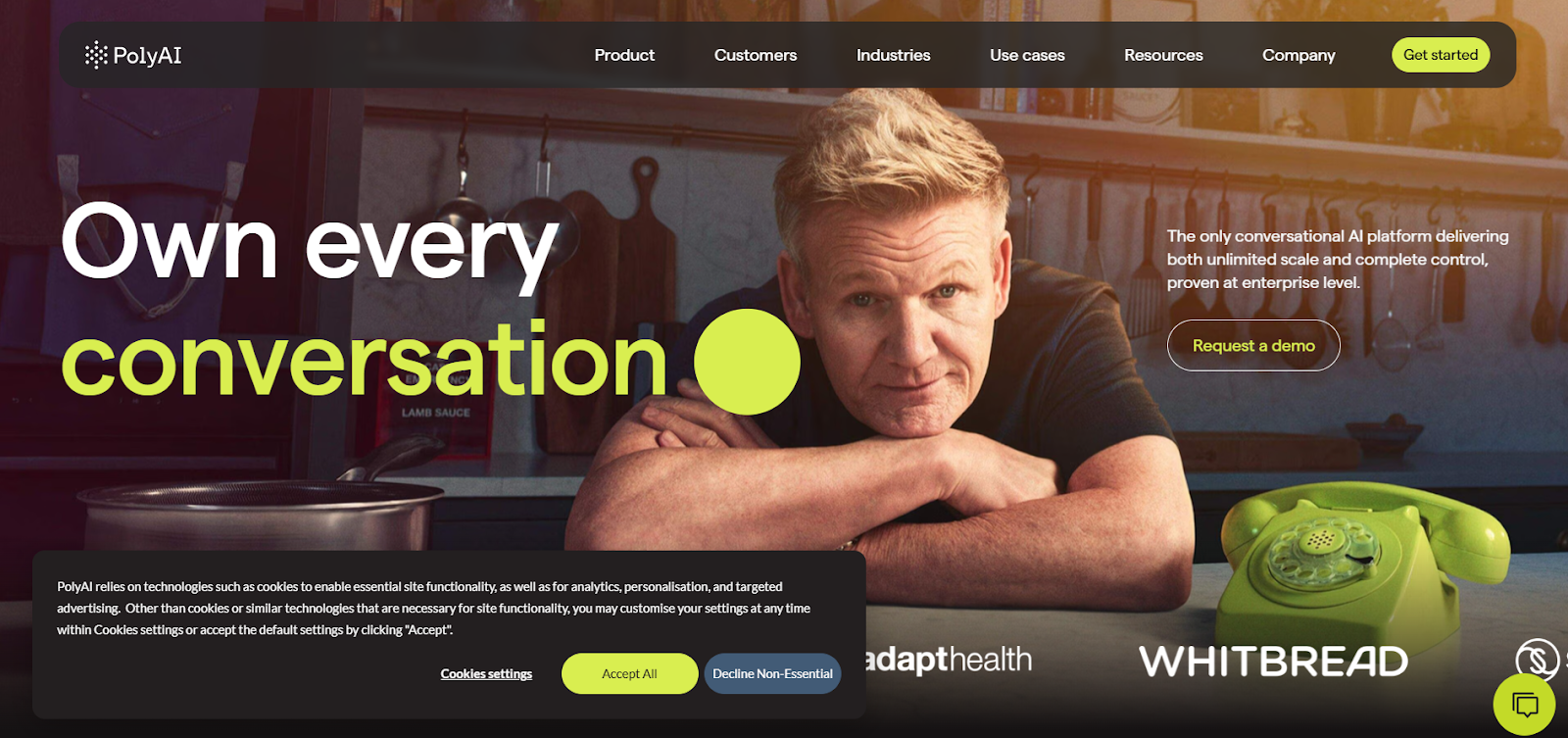
PolyAI delivers enterprise-grade conversational voice assistants designed specifically for customer service automation. Its platform enables natural, human-like conversations that replace traditional IVR systems while improving the caller experience.
Key Call Deflection Capabilities
- Conversational IVR with natural language understanding
- Seamless handoff to live agents when necessary
- Support for FAQs, bookings, and order inquiries
- 24/7 automated customer support
Ideal For: Enterprises and mid-sized contact centers seeking human-like automation that reduces inbound call volume while preserving conversational quality.
Pricing: Poly AI’s pricing is typically subscription-based with usage tiers tied to conversation volume. Costs vary based on deployment scale and customization requirements.
2. Goodcall
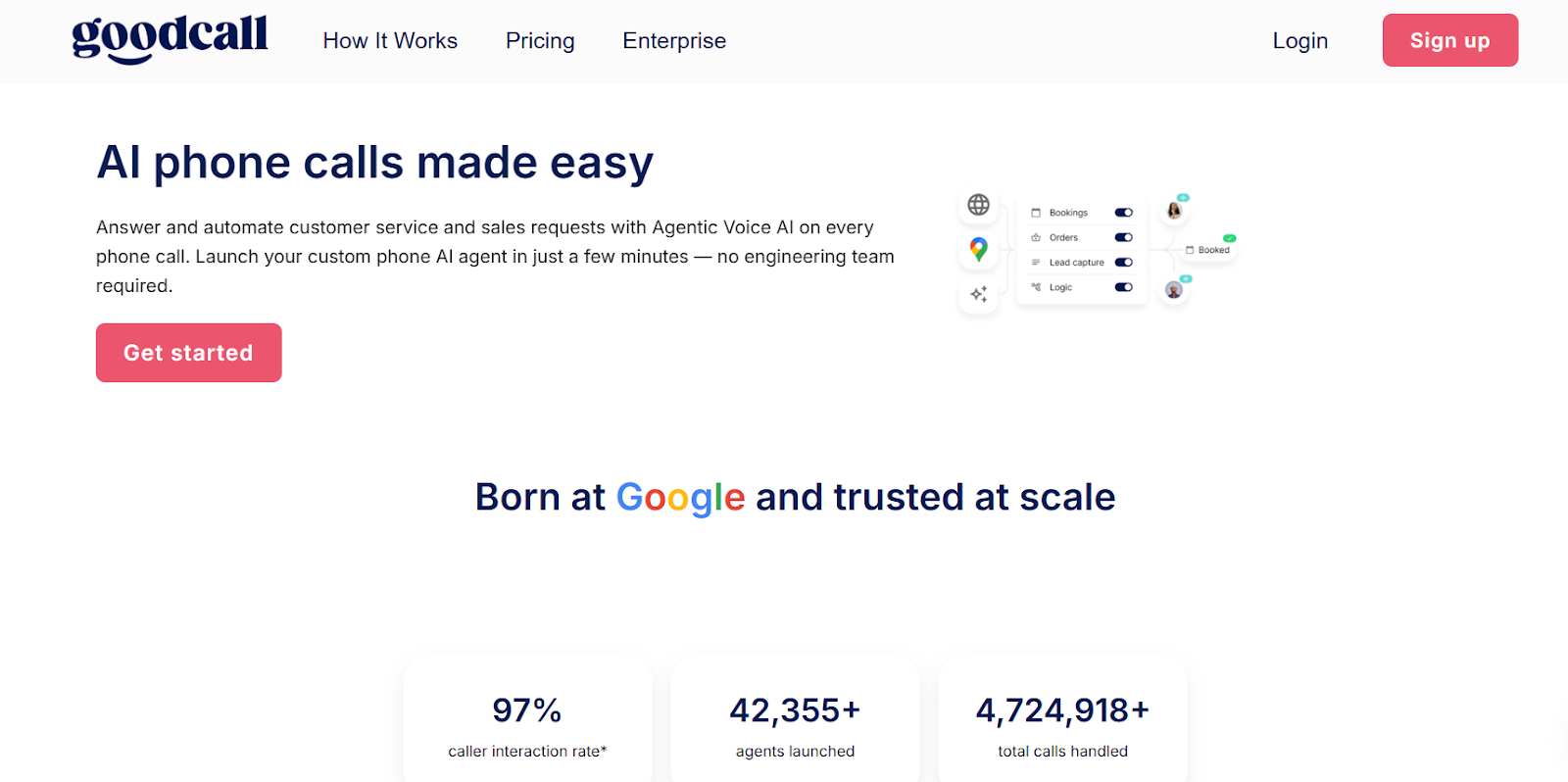
Goodcall provides an AI-powered voice automation platform focused on small and midsize businesses. It functions as AI receptionist software, answering calls, capturing leads, and automating customer interactions.
Key Call Deflection Capabilities
- Intent-driven voice assistants for routine queries
- Intelligent routing to the right agent or channel
- Integration with customer support platforms
- Self-service options for common call types
Ideal For: Businesses aiming to implement AI call deflection software that enhances support response time and integrates seamlessly with existing CX tools.
Pricing: Goodcall offers flexible pricing with modular options based on the features chosen and call volume. Enterprise and SMB packages differ in customization and support levels.
3. Google Contact Center AI (CCAI)
Google Contact Center AI combines conversational AI, speech recognition, and machine learning to automate customer support calls. It elevates service quality with intelligent routing and virtual agent workflows.
Key Call Deflection Capabilities
- Conversational AI for call deflection and routing
- Real-time speech recognition and intent detection
- Chatbots that unify voice and digital channels
- Automated responses to routine customer inquiries
Ideal For: Large enterprises and global organizations needing premium enterprise voice AI platform capabilities backed by Google’s AI research.
Pricing: Google CCAI uses usage-based pricing tied to voice minutes and AI interactions, with no upfront hardware costs. Additional charges may apply for advanced analytics and integrations.
4. Bland AI
Bland AI provides programmable voice AI agents designed to automate inbound and outbound phone conversations at scale. Its platform enables businesses to deploy highly customizable voice bots for support, qualification, and operational workflows.
Key Call Deflection Capabilities
- AI voice bot for customer support and inquiries
- Real-time conversational call handling
- Automated appointment scheduling and follow-ups
- API-driven workflow automation
- Scalable outbound and inbound call automation
Ideal For: Tech-driven businesses, startups, and enterprises seeking flexible AI call deflection software with programmable voice workflows and rapid deployment capabilities.
Pricing: Bland AI typically offers usage-based pricing based on call minutes and automation volume. Custom enterprise pricing is available for large-scale deployments and advanced integrations.
5. Synthflow AI
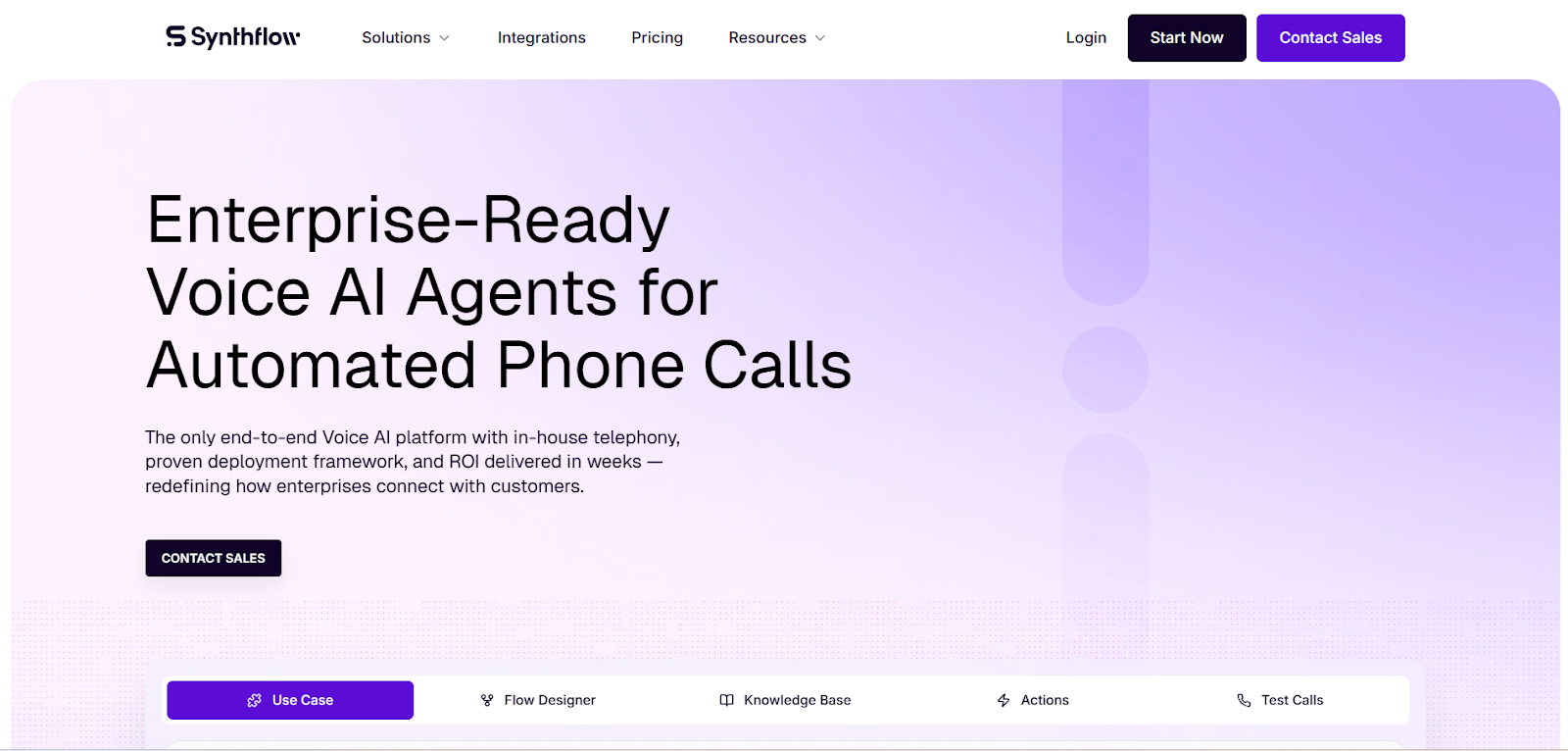
Synthflow AI delivers no-code voice AI agents that automate customer calls, bookings, and support interactions. The platform focuses on fast deployment, enabling businesses to launch conversational voice automation without engineering resources.
Key Call Deflection Capabilities
- No-code AI receptionist software deployment
- Automated call routing and qualification
- Appointment booking and reminders
- CRM-integrated customer conversations
- Multilingual voice automation support
Ideal For: SMBs, agencies, and service businesses looking for voice AI solutions for SMBs that simplify deployment while reducing inbound call volume.
Pricing: Synthflow AI provides subscription-based pricing with tiered plans aligned to call volume and feature access. Higher tiers include advanced integrations and workflow customization.
6. Five9
Five9 provides an end-to-end cloud contact center platform powered by intelligent voice automation. Its AI capabilities combine conversational self-service, agent assist, and workflow orchestration to streamline support operations and improve customer engagement at scale.
Key Call Deflection Capabilities
- AI voice bot for customer support handling routine inquiries
- Intelligent virtual assistant for phone calls with natural language conversations
- Automated call routing system based on intent and customer data
- Omnichannel deflection to chat, SMS, and self-service portals
Ideal For: Mid-size to enterprise contact centers seeking scalable call center automation platforms with strong analytics and workforce optimization tools.
Pricing: Five9 uses subscription-based SaaS pricing tailored to seat count, usage, and AI features. Enterprise deployments typically involve customized licensing and implementation costs.
How to Choose the Right Voice AI Platform for Your Business
Selecting the right solution requires aligning automation capabilities with customer experience goals and operational scale. Here’s a practical framework to guide your decision-making process:
1. Define Deflection Objectives
Organizations must identify which calls to deflect first. Common targets include:
- Billing inquiries
- Appointment scheduling
- Order tracking
- Password resets
Clear goals help configure AI call deflection software effectively.
2. Evaluate Conversation Complexity
Not all platforms handle complex, multi-turn conversations effectively. Organizations must assess whether they need basic FAQ automation or advanced conversational AI for call centers that can handle troubleshooting, transactions, and contextual follow-ups. Higher complexity requires stronger natural language understanding and training datasets.
3. Integration With Existing Tech Stack
Seamless integration ensures voice AI works within existing workflows. Platforms should connect with:
- CRM systems
- Workforce management tools
- Payment gateways
- Knowledge bases
Deep integrations enable intelligent virtual assistants for phone calls to deliver personalized responses and automate end-to-end service processes efficiently.
4. Scalability and Deployment Model
Businesses must evaluate whether the platform supports cloud, on-premise, or hybrid deployment. Scalable enterprise voice AI platforms handle seasonal spikes, multi-location operations, and high concurrent call volumes without latency, ensuring consistent performance as customer demand grows.
5. Support for SMB Use Cases
Requirements differ significantly between small businesses and large enterprises. Voice AI solutions for SMBs prioritize fast deployment and prebuilt templates, while enterprise deployments require customization, advanced analytics, compliance controls, and workforce orchestration across global contact centers.
6. Security and Compliance Readiness
Voice interactions often contain sensitive personal and financial data. Platforms must meet regulatory standards such as HIPAA and PCI DSS and follow frameworks set by recognized authorities. Strong encryption, access controls, and audit logs are essential for secure deployments of AI receptionist software.
KPIs That Define Successful Call Deflection
Measuring performance ensures continuous optimization of AI call deflection software. Here are the key KPIs that define success:
- Call Deflection Rate: The percentage of inbound calls successfully handled by Voice AI without requiring a live agent. This is the primary indicator of automation effectiveness.
- Containment Rate: Measures how many conversations are fully resolved within the AI system from start to finish, without escalation.
- Average Handle Time (AHT): Evaluates how much AI automation reduces the time spent per customer inquiry compared to traditional agent-led calls.
- First Call Resolution (FCR): Tracks whether customer issues are resolved in the first interaction without repeat contact.
- Escalation Rate: The percentage of interactions transferred to human agents. A high rate may indicate gaps in training data, intent recognition, or workflow design.
- Customer Satisfaction (CSAT): Post-interaction feedback scores that measure how customers feel about their automated support experience.
- Cost per Contact: Compares the operational costs of AI-handled interactions vs. live-agent calls to determine ROI.
Common Call Deflection Challenges and Solutions
Even the leading platforms for voice AI in call deflection face operational and technical barriers during implementation. Understanding common obstacles helps businesses deploy AI call deflection software more effectively. Let’s look at some common challenges:
1. Inaccurate Intent Recognition
Early-stage voice models may misunderstand caller intent, leading to frustration and unnecessary escalations.
Solution: Continuously train conversational AI for call centers using historical call transcripts and real interaction data. Ongoing model refinement improves accuracy and containment rates over time.
2. Customer Resistance to Automation
Some customers prefer speaking directly with human agents, especially for sensitive or complex issues.
Solution: Design automation with transparent escalation options. A seamless handoff from an AI voice bot for customer support to live agents builds trust while preserving efficiency.
3. Over-Deflection of Complex Issues
Attempting to automate highly complex scenarios can reduce satisfaction and increase repeat calls.
Solution: Define clear escalation thresholds within the automated call routing system. Allow AI to handle routine requests while transferring edge cases to human reviewers.
4. Integration Limitations
Legacy infrastructure often lacks the APIs required for modern AI integrations. This restricts automation capabilities and data access.
Solution: Adopt middleware layers or integration platforms. Many call center automation platforms offer prebuilt connectors to accelerate deployment.
5. Compliance and Data Privacy Risks
Voice interactions may capture payment details, health records, or personal identifiers. Mishandling this data creates regulatory exposure.
Solution: Deploy secure AI call deflection software with encryption, redaction, and compliance certifications aligned with industry regulations.
6. Poor Conversational Design
Rigid scripts and robotic responses reduce engagement and increase call abandonment.
Solution: Invest in conversational UX design. Natural, human-like dialogue improves containment, satisfaction, and long-term adoption of AI receptionist software.
Future Trends in Voice AI for Call Deflection
Voice AI continues evolving rapidly, transforming how businesses handle customer interactions and support operations.
- Generative AI Voice Agents: Generative AI enables voice agents to handle unscripted, complex conversations, improving resolution accuracy and significantly reducing inbound call volume across contact centers.
- Emotion and Sentiment Detection: Advanced voice AI analyzes tone and speech patterns to detect frustration or urgency, enabling intelligent routing and improving customer satisfaction.
- Proactive Call Deflection: AI systems predict customer issues and deliver proactive SMS or app notifications, preventing unnecessary calls and improving operational efficiency.
- Multilingual and Dialect Support: Modern conversational AI for call centers supports multiple languages and regional dialects, expanding accessibility for diverse US customer bases.
- Voice Biometrics Authentication: Voice biometrics verifies identity using unique voiceprints, accelerating authentication while strengthening fraud prevention and compliance readiness.
- Continuous Self-Learning Models: AI call deflection software increasingly self-trains using interaction data, improving intent accuracy and containment rates over time.
Final Thoughts
The leading platforms for voice AI in call deflection are redefining how businesses manage customer conversations. By automating routine inquiries, enabling intelligent routing, and delivering 24/7 support, these platforms reduce inbound call volume while improving speed, accuracy, and customer satisfaction.
As conversational AI continues advancing, organizations that invest early gain measurable cost savings and scalable service capabilities. The right voice AI strategy transforms call centers from reactive support hubs into proactive, experience-driven engagement engines.
Call deflection shouldn’t feel robotic. Book a 14-day free demo and see how Goodcall blends automation with natural conversations to reduce costs and elevate every caller interaction.
FAQs
What is the best voice AI platform for call deflection?
The best platform depends on business size, integration needs, and automation goals. Enterprises prefer Google CCAI or Amazon Connect, while SMBs adopt lightweight AI call deflection software with faster deployment.
How does voice AI reduce call center costs?
Voice AI automates repetitive inquiries, reducing agent workload. It lowers staffing needs, shortens handle time, and improves containment. This drives measurable savings across call center automation platforms.
Is voice AI better than traditional IVR?
Yes. Conversational AI understands natural speech, unlike menu-based IVR. It resolves issues faster, improves satisfaction, and enables intelligent routing through automated call routing systems.
Can small businesses use voice AI for call deflection?
Yes. Many vendors offer voice AI solutions for SMBs with prebuilt workflows. These tools require minimal setup and function as AI receptionist software for inbound calls.
What industries benefit most from call deflection AI?
Healthcare, banking, telecom, retail, travel, and utilities benefit most. These sectors handle high call volumes, making them ideal for conversational AI in call centers.
What is a call deflection in contact centers?
Call deflection redirects inbound calls to automated systems or digital channels. It uses AI voice bots, self-service portals, and messaging to resolve issues without agents.
How much can an AI voice agent for call deflection achieve?
Advanced AI voice agents can deflect 50–80% of routine calls. Performance depends on training data, integrations, and conversational design maturity.