

Best Voice AI Agents for Reducing Average Handle Time Without Hurting CX
.jpg)
In business, every second of customer conversation carries a price tag. When long call durations inflate costs and frustrate customers, Average Handle Time (AHT) quietly becomes the metric that can make or break operational efficiency. The smartest companies today aren’t hiring more agents, but deploying intelligent Voice AI to work faster, smarter, and around the clock.
In this blog, we’ll explore how voice automation for businesses improves performance and compare the best voice AI agents for reducing average handle time.
What Is Average Handle Time (AHT) & Why It Matters
Average Handle Time (AHT) is one of the most critical performance metrics in contact centers. It measures the average total time an agent spends handling a customer interaction, including talk time, hold time, and after-call work, from start to finish. In simple terms, AHT tells you how long it takes to resolve a customer’s issue fully.
AHT typically includes:
- Talk time
- Hold time
- After-call documentation
- System updates
AHT directly impacts operational costs, agent productivity, and customer satisfaction. A lower (but well-optimized) AHT means faster resolutions, reduced queue times, and better resource utilization, while an inefficient AHT can signal process gaps, training issues, or outdated systems.
How Voice AI Agents Reduce Average Handle Time
Modern automated voice agents do more than answer calls. They resolve issues, route intelligently, and automate post-call workflows. Here is how they reduce average handle time in measurable ways:
1. Instant Intent Recognition
Voice AI agents use advanced natural language understanding to decode what callers want right from the first sentence, eliminating the need for long menu trees or repetitive questioning. This real-time intent detection can reduce average handle time by 30-50% as AI automates common tasks immediately rather than queuing them for a human agent, leading to faster resolutions and fewer transfers.
2. Intelligent Call Routing
Instead of forcing customers through rigid menus, automated voice agents intelligently route calls to the most appropriate resource (self-service system or skilled agent) based on the caller’s intent and history. This precision routing reduces misrouted transfers, with AI-powered routing decreasing transfer rates by up to 40% and cutting wait times, significantly lowering AHT.
3. Automated Authentication
Verifying a caller’s identity traditionally eats into handle time, with agents taking precious seconds to ask security questions and manually check records. Conversational AI software can use voice biometrics and contextual data to quickly authenticate callers, cutting authentication steps by 70% and allowing conversations tofocus on issue resolution, reducing average handle time.
4. Self-Service Resolution
AI voice systems can completely handle up to 80% of routine calls on their own, from FAQs to appointment booking and simple account queries, without ever involving a human agent. This self-service capability dramatically shortens handle time by resolving interactions on the spot.
5. Higher First-Call Resolution
By resolving issues or routing calls correctly the first time, voice AI boosts first-call resolution rates, which directly impacts AHT. Contact centers using AI see faster resolution times and fewer escalations, translating to calls that end sooner and don’t circle back for repeat handling.
6. Automated After-Call Documentation
After a call ends, AI can automatically generate summaries, update CRM records, and complete ticketing tasks without human intervention. This reduces after-call work, one of the hidden drains on AHT, by instantly capturing data that would otherwise take agents extra minutes per call.
A Quick Look at the Best Voice AI Agents for Reducing AHT
The best voice AI agents for reducing average handle time combine automation, intelligent routing, and conversational AI software to eliminate delays across customer interactions.
Here are the leading voice AI platforms that help businesses reduce average handle time through advanced voice automation for businesses:
- Goodcall – AI-powered voice automation for businesses.
- Five9 – Enterprise cloud contact center automation platform.
- Retell AI – Developer-focused conversational AI voice infrastructure.
- ElevenLabs – Advanced AI voice synthesis and speech technology.
- PolyAI – Natural, enterprise-grade automated voice agents.
- Cognigy – Enterprise conversational AI software platform.
- Vapi AI – Programmable voice bot for customer support.
- Genesys – Omnichannel CX with predictive AI routing.
Talkdesk – AI-driven contact center efficiency platform.
| Platform | Key Features | AHT Impact | Pricing |
|---|---|---|---|
| Goodcall | Real-time intent recognition, automated voice flows, CRM integration | High containment reduces talk time and transfers | Usage-based, scales with call volume |
| Five9 | AI IVR alternative, predictive routing, agent assist | Reduces transfers and after-call work | Subscription, enterprise plans |
| Retell AI | API-driven conversational automation, low latency | Fast intent detection shortens calls | Usage/API-based pricing |
| ElevenLabs | Realistic AI voice synthesis | Improves comprehension, reduces repetitions | Tiered voice generation plans |
| Genesys | Predictive routing, intelligent automation | Cuts hold time and transfers | Subscription with modular add-ons |
| Cognigy | Omnichannel automation, workflow orchestration | Reduces manual tasks and call duration | Enterprise subscription pricing |
| Vapi AI | Programmable voice bots, real-time transcription | Limits escalations, speeds resolutions | Usage-based with scalable tiers |
| Talkdesk | AI-driven routing, analytics, and self-service | Reduces repeat calls and wrap-up time | Tiered subscription plans |
| PolyAI | Natural conversational agents, high containment | Drives large AHT reductions in high volume | Quote-based enterprise pricing |
Best Voice AI Agents for Reducing Average Handle Time
1. Goodcall
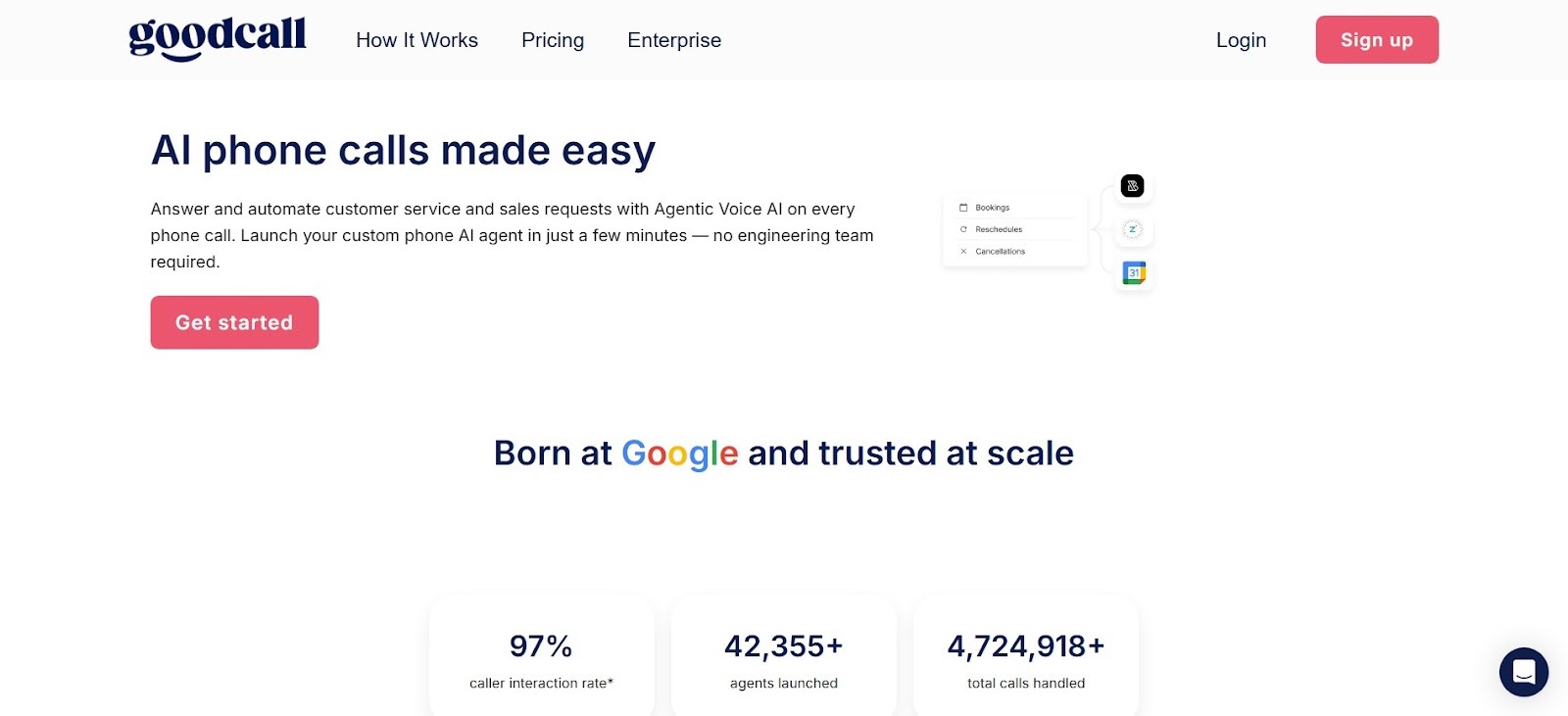
Goodcall delivers advanced voice automation for businesses through intelligent, agentic AI voice agents. It combines instant intent detection, automated authentication, and real-time CRM integration to reduce average handle time while improving first-call resolution and operational scalability.
Best for: SMBs and mid-sized US businesses seeking scalable automated voice agents
AHT Impact: High containment rates and instant routing significantly reduce call duration and eliminate repetitive agent tasks.
Pricing: Custom pricing based on call volume and deployment scope. Designed to lower call center costs through automation-driven efficiency gains.
2. Five9
Five9 provides enterprise-grade conversational AI software within its cloud contact center platform. Its predictive routing, intelligent virtual agents (IVAs), real-time agent assistance, and automated voice agents streamline call flows, minimize transfers, and reduce after-call work.
Best for: Mid-to-large enterprises requiring full-scale cloud contact center infrastructure.
AHT Impact: Predictive routing and self-service automation can significantly reduce call duration and improve first-call resolution.
Pricing: Subscription-based enterprise pricing. Costs vary by seat count, AI features, and usage volume, with tiered packages available.
3. Retell AI
Retell AI provides developer-focused conversational AI software for building programmable automated voice agents. Its real-time speech recognition, low-latency responses, and API-driven workflows help businesses reduce average handle time through fast intent capture and streamlined automation.
Best for: Startups and tech-driven teams building custom voice automation for businesses.
AHT Impact: Rapid intent detection and workflow automation reduce call duration and minimize manual agent intervention.
Pricing: Usage-based pricing aligned with API consumption and call volume. Flexible for scalable deployments.
4. ElevenLabs
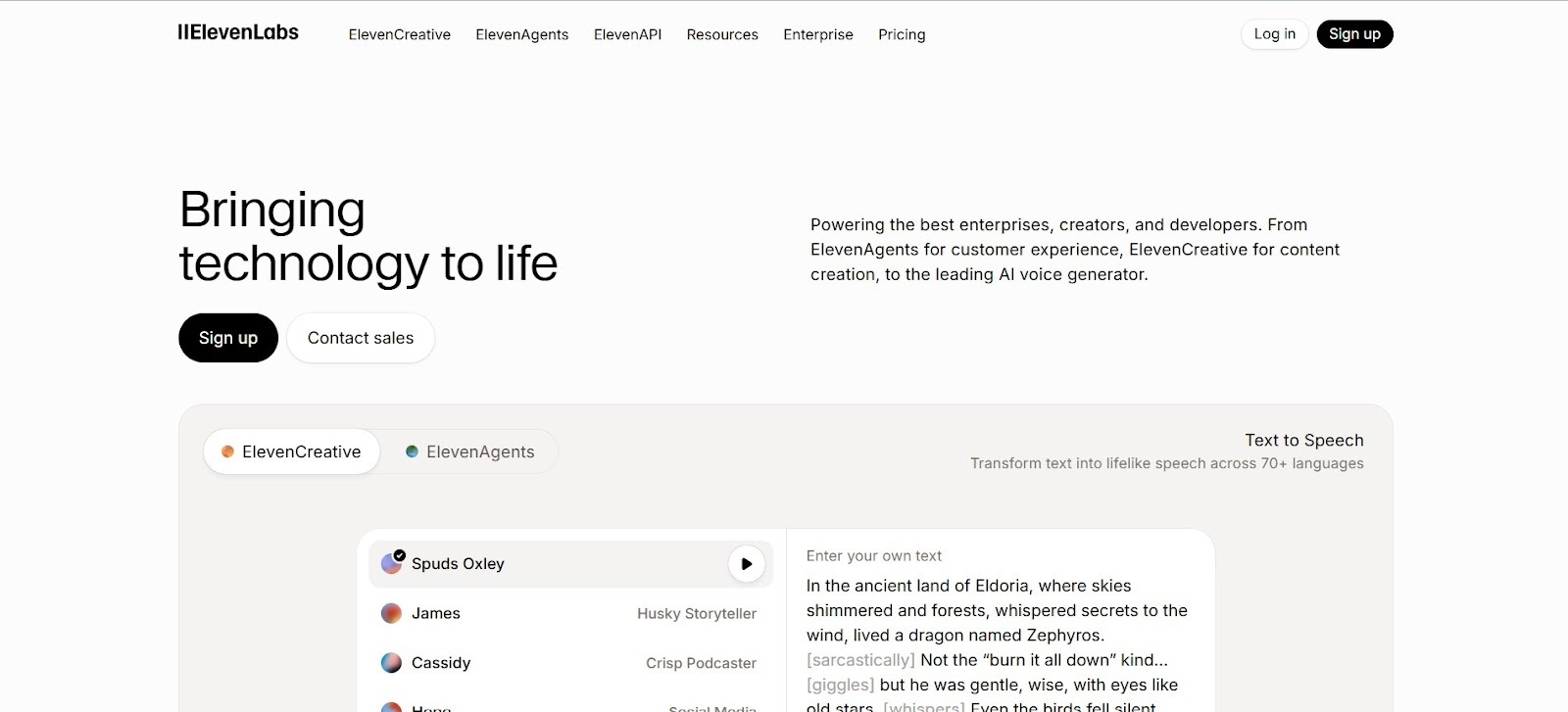
ElevenLabs specializes in advanced AI voice synthesis and speech generation. While primarily known for high-quality voice models, it enables businesses to power voice bots for customer support with natural-sounding interactions that improve clarity and reduce misunderstandings.
Best for: Businesses prioritizing ultra-realistic voice experiences in automated voice agents.
AHT Impact: Clear, human-like speech reduces repetition and improves customer comprehension, helping reduce average handle time.
Pricing: Tiered pricing plans based on voice generation usage and API access. Enterprise customization available.
5. PolyAI
PolyAI delivers enterprise-grade automated voice agents designed for high-volume contact centers. Its conversational AI software handles complex, multi-turn conversations naturally, reducing transfers and containment failures. Strong integration capabilities support seamless voice automation for businesses.
Best for: Large US enterprises managing high volumes of inbound calls.
AHT Impact: High self-service containment and fewer escalations significantly reduce average handle time and improve call center efficiency.
Pricing: Enterprise, quote-based pricing depending on call volume, integrations, and customization needs.
6. Cognigy
Cognigy offers enterprise conversational AI software that powers intelligent voice and chat automation. Its AI IVR alternative and intelligent call routing software streamline call flows, automate repetitive tasks, and accelerate resolution across customer support operations.
Best for: Enterprises seeking omnichannel automation with strong workflow orchestration.
AHT Impact: Automated workflows and smart routing reduce call duration and improve first-contact resolution rates.
Pricing: Subscription-based enterprise pricing tailored to deployment scale and feature requirements.
7. Vapi AI
Vapi AI provides programmable voice infrastructure that enables developers to build advanced automated voice agents quickly. Its API-first architecture supports real-time transcription, dynamic workflows, and seamless integrations that help reduce average handle time through faster resolution and intelligent automation.
Best for: Developer-led teams building custom voice automation for businesses.
AHT Impact: Streamlined workflows and instant intent processing reduce call duration and limit unnecessary agent escalations.
Pricing: Usage-based pricing tied to call volume and API consumption. Scales efficiently with growing automation needs.
8. Genesys
Genesys delivers enterprise conversational AI software through its Cloud CX platform. Its predictive routing, AI IVR alternative, and real-time agent assist tools help businesses reduce average handle time while improving first-call resolution and overall service consistency.
Best for: Large enterprises seeking comprehensive intelligent call routing software and omnichannel orchestration.
AHT Impact: Predictive routing and automation significantly reduce transfers, hold times, and after-call work.
Pricing: Subscription-based enterprise pricing with modular add-ons. Costs vary based on deployment scale and AI capabilities.
9. Talkdesk

Talkdesk provides AI-powered cloud contact center software with built-in conversational AI and intelligent call routing software. Its AI IVR alternative, automated voice agents, and real-time agent assist tools help businesses reduce average handle time while maintaining consistent service quality.
Best for: Mid-to-large US businesses seeking scalable voice automation for businesses with strong analytics.
AHT Impact: AI-driven routing, self-service containment, and automated summaries reduce call duration and improve call center efficiency.
Pricing: Subscription-based pricing with tiered plans and optional AI add-ons. Enterprise customization is available based on usage and features.
How to Choose the Right Voice AI Agent for Your Business
Selecting the best voice AI agents for reducing average handle time requires clear evaluation criteria.
1. Measure Your Current AHT Drivers
Identify whether long handle times stem from:
- Authentication delays
- Multiple transfers
- Manual documentation
- Repetitive inquiries
Voice automation for businesses should target the largest friction points first.
2. Evaluate Intent Recognition Accuracy
Conversational AI software must accurately detect intent across accents and phrasing variations. Poor recognition increases escalations and repeat calls. High NLP accuracy directly helps reduce average handle time.
3. Assess Intelligent Call Routing Capabilities
Intelligent call routing software should match callers with the correct department instantly. Look for predictive routing that uses real-time data and customer history. Proper routing reduces transfers and shortens resolution time.
4. Review Integration With Existing Systems
Voice automation for businesses must integrate with CRM, helpdesk, telephony, and analytics tools. Seamless integration reduces after-call work and eliminates duplicate data entry. Disconnected systems increase overall handle time.
5. Examine Security and Compliance Standards
Businesses must protect customer data. Ensure the intelligent call routing software vendor follows recognized standards and encryption practices. Secure authentication reduces manual verification steps while maintaining compliance.
6. Demand Analytics & Reporting
Look for dashboards that track:
- AHT trends
- Containment rates
- Escalation frequency
- First-call resolution
Without data, it is impossible to optimize automation.
7. Consider Scalability and Customization
As call volumes grow, automation must scale without performance issues. Flexible conversational AI software allows workflow customization and expansion. Scalability ensures long-term ability to reduce call duration and lower call center costs.
AI Voice Agents vs Human-Only Support vs Hybrid Model To Maximize AHT Reduction
Businesses aiming to deploy the best voice AI agents for reducing average handle time must decide among automation, human agents, or a hybrid approach. The most effective strategy combines both.
Human-Only Support Limitations
Human agents provide empathy and complex problem-solving. However, human-only models struggle with scale and consistency. Routine tasks such as password resets or balance inquiries consume valuable agent time. This increases staffing needs and raises labor costs. Human variability also affects performance, as not all agents handle calls at the same speed or with the same level of accuracy.
The Risks of AI-Only Automation
Automated voice agents excel at speed and consistency. They provide instant responses and eliminate repetitive work. However, fully automated systems may struggle with emotional nuance or highly complex issues.
Poorly designed AI IVR alternatives can frustrate customers and increase repeat calls. Over-automation without escalation pathways can negatively impact customer satisfaction.
Hybrid Model Advantage
A hybrid system combines:
- AI IVR alternatives for intent capture
- Intelligent call routing software
- Self-service resolution
- Seamless agent escalation
This structure reduces average handle time while preserving customer satisfaction. AI can handle routine requests. Human agents can handle nuanced cases while delivering empathy and judgment
The result:
- Lower call center costs
- Higher first-call resolution
- Reduced call duration
- Improved service consistency
For businesses seeking to improve call center efficiency, hybrid deployment is often the most practical strategy.
Voice AI Driving Faster Conversations at Scale
The best voice AI agents for reducing average handle time are no longer optional for competitive US businesses. Intelligent automation, real-time routing, and conversational AI software now make it possible to reduce average handle time without sacrificing customer experience.
Organizations that adopt automated voice agents within a hybrid model consistently improve call center efficiency, lower call center costs, and reduce call duration at scale. The companies that move first will lead with faster resolutions, smarter operations, and stronger customer loyalty.
AHT rising? Stop losing revenue to long calls. With Goodcall, automate smarter, resolve faster, cut costs, improve CX, and maximize agent productivity.
FAQs
What is the fastest way to reduce average handle time?
The fastest way to reduce average handle time is to implement automated voice agents with intelligent call routing software. Automation removes repetitive tasks, reduces transfers, and shortens authentication time immediately.
How much can AI reduce average handle time?
Most businesses see 15–40% reductions after deploying conversational AI software. Results depend on containment rates, integration quality, and how effectively automation targets repetitive inquiries.
Are voice AI agents better than IVR?
Yes. AI IVR alternatives use natural language processing instead of rigid menu trees. This improves intent detection, reduces misrouting, and shortens call duration compared to traditional IVR systems.
Is AI voice automation expensive?
Pricing varies by vendor and volume. However, voice automation for businesses often lowers call center costs significantly through labor savings and efficiency gains, offsetting initial investment.
Does reducing AHT hurt customer experience?
Not when implemented correctly. When automated voice agents resolve issues quickly and escalate intelligently, businesses can reduce average handle time while improving satisfaction and first-contact resolution.